Facebook
 X
X
 Pinterest
 Copy Link
The Showing Process

The fun part of the home buying experience is going out on showings. You’ll go on dozens of showings during your home search, so this section sets out everything you need to know about the showing process.
The foundation of the home search process is the property “showing,” which is an appointment set by your agent to go visit a property or a series of properties. Even though it can be a lot of work, most of our clients actually enjoy this part of the process. There’s something exciting about every showing: the anticipation of seeing the home live that you’ve only before seen in pictures, the suspense of wondering whether this will be “the one,” the fun in imagining what it would be like to live in each home. Even more importantly, every showing you do is part of your educational process in refining your understanding about your own preferences, helping you and your agent learn about what you like and don’t like.
The Basics
Here are some basic rules of thumb for what you need to know about showing appointments with your agent:
•Scheduling. The process of setting up a showing is very simple. You identify a series of properties that you’d like to visit, find a window of time when both you and your agent are available, and then your agent will contact all the sellers or listing agents to make an appointment to see the home. It’s your agent’s job to set the appoin tments, not yours – that’s one of the reasons you hired your own agent.
•Notice. Generally, you don’t need to give more than 24 hours notice before setting up a showing. Most sellers are eager to have agents show their homes, and will agree to showings on very little notice. Some sellers do require more extensive notice, though, something your agent will be able to determine from the property information accessible to brokers in the MLS.
•Time Commitment. You’ll usually spend about 15-30 minutes in the actual showing of the home, depending on your level of interest, but remember that you also have to factor in travel time. If you’re seeing a lot of homes in a very small geographic area, you might be able to see three or four homes in an hour. But if you have to drive a long ways between homes, then you might only get to one or maybe two in an hour. Your agent will have a good sense of the schedule.
•Traveling to Showings. Whether you travel together or separately is up to you and your agent. Having the agent with you can be helpful for facilitating conversation and feedback between showings (and is environmentally preferable!), but sometimes you all can’t fit in one car.
•What You’ll Get. When you meet with your agent to start the series of showings, you’ll probably get paperwork on all the listings you’re going to see. It’s a good idea to get a folder to keep all those “showing sheets,” because you’ll eventually see so many homes that it’ll be tough to keep them organized in your head. Keeping the show sheets, and taking notes on those sheets, is a good way to keep track of the properties you’ve seen and what you thought about them.
•Feedback. After showings, or during showings if you are alone, you should give feedback to the agent about what you liked and didn’t like, so long as the seller or listing agent aren’t present. You should be as honest as possible in communicating your interest to your agent, who needs that kind of information to learn about you and your preferences. Your agent might also ask you to give formal feedback that can be communicated back to the seller, particularly for properties that you’re not really interested in. Sellers appreciate that, because it sometimes helps them adjust their price or presentation of the home. You’re not under any obligation to do so, but it’s considered polite to provide feedback if asked.
•Canceling Appointments. If you have to cancel a showing after setting an appointment, just try to give as much notice as possible to your agent, who will then cancel the appointments with the seller or listing agent. It’s no big deal to cancel an appointment, although it’s very discourteous to simply not show up when you were expected.
 What to Do At a Showing
 What to Do At a Showing
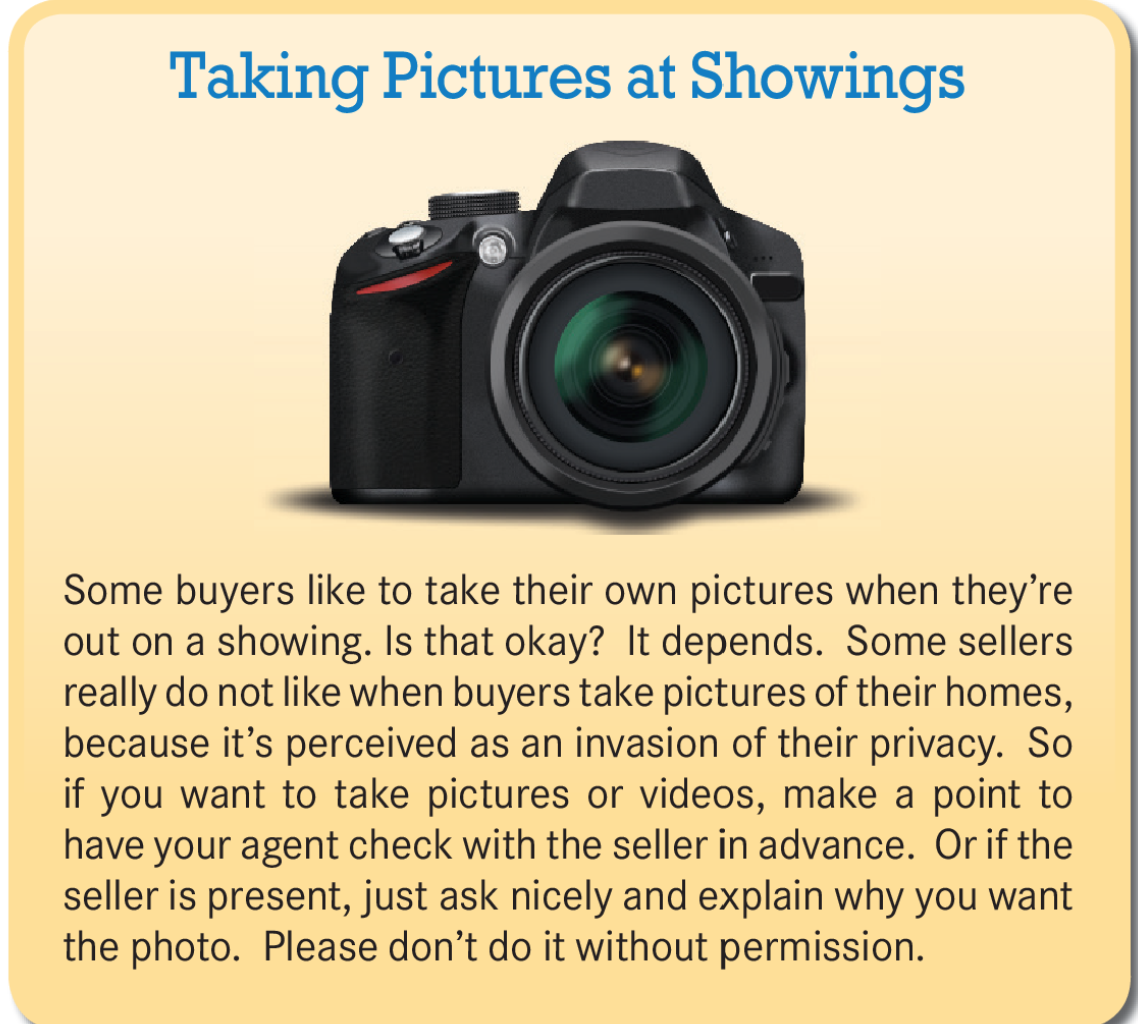
Okay, so now that we’ve covered the basics, we come to a more important question: what exactly should you do at a showing? To answer that question, here are some suggestions for how to make the most out of a showing appointment:
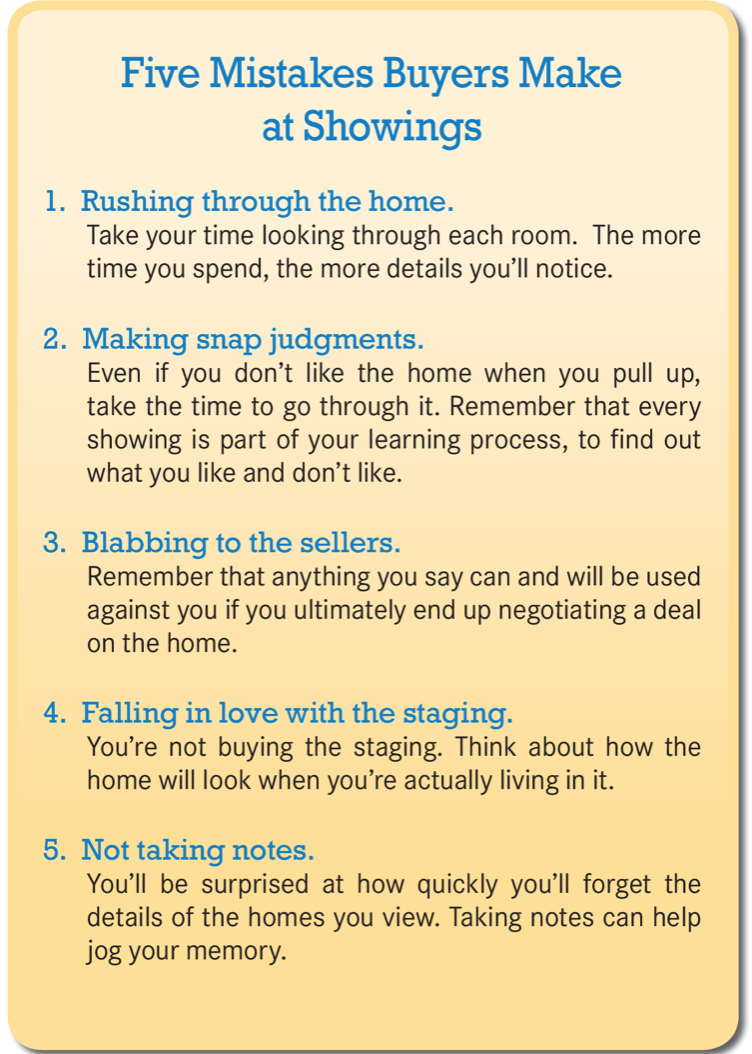
•Keep an open mind. Sometimes, you’ll pull up to the front of the property, and you’ll immediately make a snap decision that this is not the home for you. That’s fine. Tell your agent why. But you should still go into the house to look around. Why? Because we have many buyers who ended up buying a home that they absolutely hated on the first impression they got on the curbside. But even more importantly, you’ve already taken the time to drive over, you might as well go inside. Even if you don’t like the home, you might find something about it that you do in fact like, and your agent can learn from that. Every showing is part of the educational process of learning what you like and don’t like, so always keep an open mind regardless of your initial impressions of a home you’re seeing.

•Try to visualize yourself living there. A great way to develop a good feel for whether this is the right home for you is to just imagine yourself living there. Think about what it would be like to wake up every morning in the master bedroom, to make breakfast in the kitchen, to have meals in the dining room, to sit back and watch television. Visualize where your furniture would go, and how it would look in the home. Essentially, try to imagine what it’s like to live there. If you like that image, then this might be a home you want to consider buying.
•Feedback. After showings, or during showings if you are alone, you should give feedback to the agent about what you liked and didn’t like, so long as the seller or listing agent aren’t present. You should be as honest as possible in communicating your interest to your agent, who needs that kind of information to learn about you and your preferences. Your agent might also ask you to give formal feedback that can be communicated back to the seller, particularly for properties that you’re not really interested in. Sellers appreciate that, because it sometimes helps them adjust their price or presentation of the home. You’re not under any obligation to do so, but it’s considered polite to provide feedback if asked.
•Canceling Appointments. If you have to cancel a showing after setting an appointment, just try to give as much notice as possible to your agent, who will then cancel the appointments with the seller or listing agent. It’s no big deal to cancel an appointment, although it’s very discourteous to simply not show up when you were expected.
 Communicating with Sellers and Listing Agents
 Communicating with Sellers and Listing Agents
Most of the time, you’ll be able to see properties with just your agent, particularly if your visit is during the workday. Sometimes, though, the sellers might happen to be home when you’re looking at the property. That can always be a little awkwa rd, particularly if the sellers hover over you or want to do the agent’s job for her by showing you the house themselves. Other times, the listing agent might be present, particularly in the rare cases where the seller demands that the listing agent attend all showings.
In those cases, it’s always a good idea to be as friendly and likeable as possible with sellers. You might end up doing a deal with them, and you’d be surprised how much basic courtesy and friendliness can facilitate a good negotiating relationship. And if you end up in any kind of bidding war for the property, you’ll find that just being a friendly person can sometimes give you a leg up in getting your bid approved. So just be nice to them. And, of course, never say anything critical or derogatory about the property (the decor, the cleanliness) in front of the seller or listing agent, because insulting the homeowner is a bad way to start a negotiation.
On the other hand, you want to be careful about what you say about your personal situation. You don’t want to give away anything that might undermine your negotiating position if you ultimately decide to make an offer, such as your level of interest in the property, how it compares to other homes, your personal finances, your urgency to move, or your price range. For example, you might think it’s harmless to answer a seller’s question about whether you’re currently renting or owning, but answering it might inadvertently reveal your urgency for moving. Similarly, remember that listing agents have a fiduciary duty to their sellers, so telling that nice agent something like “this is the best layout we’ve seen” could end up undermining your negotiating posture later. Just like in cop shows, anything you say can and will be used against you.
So when you’re talking to listing agents or sellers, just keep it on a very superficial level. Make polite compliments about the home, compliment the furnishings, ask them questions to get them talking (and maybe revealing something!), and most of all let your agent do the talking.
If they ask you direct questions that you don’t want to answer, just be vague in what you say. You don’t want to be rude by ignoring the question, nor do you want to raise hackles by “lawyering up” – saying something like “my agent told me not to talk about that.” Just say things like “we’re not sure yet, we’re very flexible” or “we’re discussing that very issue with our agent.” And then just ask them a question yourself to change the subject. Generally, you’re not going to get the third degree when you see a home, so don’t worry too much about it. Sellers generally don’t ask buyers a lot of questions, and listing agents know that they’re not supposed to ask a represented buyer anything personal.
 Working with Your Agent
 Working with Your Agent
Because you’ll be spending a lot of time with your agent, you should try to maintain an open line of communication in order to forge a strong working relationship. Here are some tips on how to work best with your agent.
During the course of your home search, your buyer agent is your best asset for helping you navigate through the inventory of properties that you might be seeing. After all, you might not have done much home-shopping, but your agent looks at houses almost every day, and can often pick out positives and negatives that you might not have noticed.
Keep these guidelines in mind when working with your buyer agent:
•First, communicate regularly with your agent. You and your agent should set up a communication plan when you first start working together. That plan is up to you – how often do you want to talk, how often do you want to get emails from your agent, how regularly do you want to go out to look at properties, etc. Talk
it out with your agent. It’s her job to serve your needs the way you want to be served, so be clear about what you want from her. Most importantly, though, find some way to stay in regular contact with your agent through the home buying process, even if it’s just a text message once in a while to update her (or her updating you) on the status of your home search.
•Second, be honest about what you like and don’t like. As your agent works with you, she will get to know your preferences, even things that you don’t yourself identify as being important to you. Maybe she’ll notice that you seem to like homes with an open floorplan, even though you originally said that you instead like traditional room layouts with more privacy. Every time you see a house with your agent, she learns something about you. So you need to be honest. If you don’t like the house, tell your agent why. Don’t feel you need to spare his or her feelings by holding back – if the agent missed the mark in selecting properties to show you, be honest about it. She’s not going to take it personally. After all – that’s her job.
•Third, don’t be reluctant to ask your agent for help. Remember that your agent makes his or her living by helping you buy a home. Sometimes, buyers feel reluctant to call their agent to take them out, because they’re early in the buying process and they don’t want to “waste” their agent’s time. But it’s your agent’s job to help you in the home-buying process, and agents will often work with buyers for months and months before the buyer finds the right home. If you’re really just “sight seeing,” or in such an early stage of your process that you don’t feel comfortable going out with your agent, then work on your own and just use your agent as a resource for information. For example, she could set you up with automatic alerts for new properties coming on the market, or let you know about open houses that you might want to visit on your own. But once you’re serious about your home search, don’t feel inhibited about calling your agent. You’re not being an imposition if you need your agent to spend a day showing you homes. That’s your agent’s job.
•Fourth, keep your agent in touch with anything you do on your own. Over the course of your home search, you might find yourself doing some work on your own in addition to all the appointment showings with your agent. You’ll probably be saving properties online on RandRealty.com, which is how most of our clients get their first look at the home they ultimately buy. Buyers also sometimes do drive-bys of properties that they see listed online, just to get a look at the property and maybe check out the neighborhood. And many of our clients also go to open houses, when sellers open the property to the public, usually on Sunday afternoons.
These three other types of “showings” are all good ways for you to get engaged in your home buying process, particularly at the beginning when you might be reluctant to go out with an agent. But just remember that looking on your own is really only a supplement for the work that you’ll do with your agent. Looking at the property online or doing a drive-by is no substitute for actually visiting the home in person accompanied by an agent who will be able to provide a professional perspective when making your evaluation. And while open houses also involve personal visits, you’ll find it’s much more efficient and effective to set your own appointments rather than being limited to Sunday afternoon visits of whatever properties happen to be open that weekend.
Planning Ahead: How to Avoid Delays in Your Transaction

 Now that you are starting to field offers, you can see the light at the end of the tunnel. Offers become agreements, agreements become contracts, and contracts become closings. Most transactions go from offer-and-acceptance through to closing smoothly:
1. The parties reach an accepted offer.
2. The buyer completes a home inspection, and has no major issues.
3. Seller’s attorney drafts contracts, and the buyer’s attorney reviews them.
4. The buyer and seller sign contracts.
5. The buyer orders a title and municipal search.
6. The buyer pursues a mortgage loan application.
7. The title report comes back, and determines that the seller’s title is insurable.
8. The buyer gets a mortgage commitment from the lender.
9. The buyer performs a walkthrough of the property.
10. Finally, everyone meets in a conference room, a bunch of documents get signed, the buyer gets a home, and the seller gets a check.
That’s most of the time. Sometimes, though, bad things happen that can delay the closing of your transaction for days, weeks, or even months. A severe delay is not common, but it does happen. In many cases, delays are unavoidable, and you just have to persevere through whatever difficulties you have to get to a closing. In other cases, though, delays are caused by a lack of preparation and planning ahead, which you really should start doing at the time you start getting reasonable offers.
As always, we believe that you should be proactive in your selling process, preparing and protecting yourself from problems that can come up in the transaction. To give you some idea of what might unnecessarily delay your closing, and what you can do about them right now to protect yourself, here is an overview:
1. Hire an experienced local real estate attorney as soon as you can.
Most people wait until they have an accepted offer to hire an attorney. Unfortunately, that can often delay your getting into contract, even to the point of risking the buyer finding another opportunity and backing out of your deal. Drafting a real estate contract, which is the seller’s attorney’s role, does not take very long, but the simple acts of finding the right attorney, scheduling a meeting, and completing a consultation so that the attorney knows what you need can cause you days or even weeks.
Accordingly, we recommend that you hire an experienced real estate attorney as soon as you can. You’re going to have to hire and pay an attorney sometime, you might as well do it while neither of you are in a rush. That way, when you do get your accepted offer and finish inspections, the contract can be in the buyer’s attorney’s office that same day.
 2. Insist on buyers getting pre-approved by a reputable lender.
 2. Insist on buyers getting pre-approved by a reputable lender.
Let’s say you get into contract, the title clears, and now you’re just waiting for the borrower to get his loan. Then you find out that the buyer is having trouble, and weeks go by while the loan winds its way through interminable processing and underwriting delays. This could definitely delay your closing.
Sometimes, no one could have foreseen the issue. Perhaps rates jumped and now the buyer needs to come up with more of a down payment. Or maybe a credit problem emerged, or someone lost a job. These things happen.
But other times, you could have avoided these kinds of delays by being more demanding of information from the buyer at the time you reached an agreement. Maybe these delays are caused because the buyer really was not qualified for the amount of money needed to buy your home, but no one knew that at the time you signed contracts. You could lose months because of this.
Accordingly, we counsel you, as we counsel all our agents, to always insist that buyers presenting offers provide a pre-approval letter from a reputable lender. A pre-approval letter is not the same thing as a commitment, and the lender is not doing much more than a superficial review of the buyer’s qualifications to purchase homes at a certain amount. It’s not a guarantee. But it’s definitely better than nothing, and it’s better than a pre-approval from some lender you’ve never heard of who hands pre-approvals out like free samples at Costco.
3. Consider ordering precautionary title and inspection reports.
The buyer is usually the party who orders title reports and inspections. The buyer needs a title report in order to obtain title insurance, and most buyers insist on a home inspection to ensure that the property does not have any serious defects. But even though you’re not required to get a title or inspection report, and even though these reports will cost you some out-of-pocket money, the peace of mind you can get, and the delays you can avoid, might be worth it.
Getting an early title report means that you will be aware of any problems with your title or your municipal search — such as an unresolved mechanic’s lien or a open building permit — with more than enough time to resolve those issues. And getting an early inspection report means that you can address issues that the buyer was going to find anyway later in the process, at a time when buyers often get cold feet.
Conclusion
If you’re interested in getting out ahead of some of the problems that can delay your home selling process, just talk to your agent about hiring an attorney, ensuring pre-approvals, and ordering title and inspection reports.
Ten Principles for Starting Your Home Search

Searching for a home can be a fun experience. When you’re thinking of buying a home, every neighborhood is one big department store filled with stuff that you might want to buy. And most people like to go look at homes – indeed, any real estate agent can tell you that her open houses are often filled with people who aren’t even thinking of moving, but just like to “window-shop” what’s on the market.
And just as real shopping is more fun than window-shopping, actually looking for a new home for yourself is a lot more interesting that just checking out open houses. You get to explore new neighborhoods and imagine what it might be like to live there. You get to walk through a home visualizing yourself having dinner there, raising your family there, having parties there – basically, living there. Even more fun, you get to see how other people live, and render snarky judgments on their decorating choices!
So enjoy this part of the process. After all, once you find the home you want to buy, the fun ends and the hard slog of contracts and mortgage papers and moving begins.
What should you look for in a home? What makes a god investment? What will make you happy? Here are 10 things to keep in mind as you start your home search.
Before you get started in your home search, we wanted to share with you 10 fundamental principles about home buying that you might find helpful.
1) Get to know the market, but don’t take forever.
Very few people are lucky enough to find their perfect home in the first showing, or even in the first couple of showings. Indeed, finding your “dream home ” in the first showing can actually be counter-productive, because you’ll immediately think about all the other homes that might be EVEN BETTER that are still out there, without realizing that you lucked into the perfect home on the first try. So take your time to get to know your market and learn the inventory. Over time, you’ll get a sense of what you like and don’t like, and what’s a reasonable expectation given your price range. That said, of course, you should eventually come to the point that you’re confident in your read on the market, which is when you need to be ready to pull the trigger. Buyers who hold out for perfection often find the market passing them buy, as one great home after another gets snapped up while they’re deep in deliberation.
2) Buy something you love, but realize you won’t love everything about it.
Buying a home is like falling in love with your spouse. You go on the market, you check out the “inventory,” and you find someone that you absolutely love and want to spend the rest of your life with. But no matter how much you might love your spouse, you’re never going to love everything about him or her. It’s the same with buying a home. You’re buying a home for $350,000, and wish you could have that extra bedroom that the $500,000 house has. But that guy buying a $500,000 house really wishes he could afford the $700,000 house and get a bigger lot. And the guy buying the $700,000 house is frustrated that he can’t get the finished basement that’s available in the $900,000 house. It’s that way all the up the scale . It doesn’t matter what price range you’re in, because there’s always SOMETHING in that home you don’t like and wish you could change. But if you could change it, then the home would be worth a little more and then you wouldn’t be able to afford it. And if you COULD afford it, you’d move up in price range and find something new to aspire to – and to be disappointed with.
3) Buy value, or where you can add value.
When you’re buying a home, don’t be so focused on finding a “steal.” In an open market, it’s very tough to find something that is severely undervalued. More importantly, you don’t need to find a “steal,” you just need to find a home with value. And as you get to know the inventory, you’ll start to see where the values are. You might find value in a well-made home in a desirable area that you believe will appreciate well. Or you might find value in a home that is in an up-and-coming area that will develop over time and boost home prices. Moreover, you should look for a home where you can ADD value: a house that doesn’t show well because of it’s condition, but which will be worth much more once you make some cheap repairs and clean it up. Or a home with property taxes that are too high, but which you think you can get reduced with a grievance. Ultimately, in the kind of market we’re in right now, finding value is relatively easy, because property values are likely to increase across the board over the next few years.
4) Keep an open mind.
Most people start their home searches with a very firm idea of what they’re looking for. But you’d be surprised at how many of them end up buying a home that is completely different from the one they thought they’d be buying. Maybe they changed their location preferences once they got to know the areas better. Maybe they realized they didn’t want a big house yet, and decided to get a condo. Maybe they fell in love with an old-fashioned Victorian layout, even thought they started out wanting a modern floor plan. That happens all the time. So while it’s important for you to have a good sense of the kind of home you want, keep an open mind during your search process, and don’t be so fixed on those goals that you miss out on opportunities you might like.
5) You’re buying the home, not the furnishings.
Smart buyers have the ability to look past the superficial nature of how a home shows. Always remember that you’re buying the home itself. You’re not buying the furnishings. You’re not buying the clutter. You’re not buying the condition: the smell of cat urine, the stained carpets, the dirty windows. All those things leave with the sellers, leaving the home itself behind. When you see something that’s cluttered, or dirty, or poorly laid out, try to look past it. See it with the eyes of a real estate professional , someone who looks at properties and just sees the location, the square footage, the amenities, the layout. Those all stay with the property. The clutter and the smells? They don’t. And it goes the other way, too. If the home is beautifully staged, don’t be so overwhelmed that you forget to think about how it will look once you’re actually living there. It might seem roomy only because the sellers took out all the clutter that you’re going to be putting in! Pay for the home, not the staging.
6) Buy within your means.
When you sit down with your loan officer, you’ll get a sense of how much home you can afford, and establish your price range. But that doesn”t mean you absolutely have to spend that much. Lots of buyers purchase a home that’s below the price range they could otherwise afford, particularly if they are first-time buyers who are looking to move up within five to seven years. They’d rather make the investment that allows them to save some money both in their down payment and their monthly costs, so they can continue to save toward a larger down payment for their next home. Or maybe it’s just that they want to be sure they can make their payments while still building a “rainy day” fund. Either way, don’t feel obligated to spend up to your maximum.
7) You’re buying not just a home, but a neighborhood.
You’ve probably heard the expression, “don’t buy the best home on the block.” Why? Because it will be tough to sell, and you’ll never get the best price for it. But that’s a little misleading. Yes, if you buy the best home on the block, you’ll never get the kind of appreciation you’d get if the home were in a nicer neighborhood. But if the home were in a nicer area, it would cost you more in the first place! The better way to think about this is to simply remember that when you buy a home, you’re buying a neighborhood, and the value of your home will reflect the quality of that neighborhood. If the area goes up or down in value, so will your home. If the area changes, for better or worse, so will your property value – regardless of whether you have the best or worst home on the block.
8) Buy with an idea of what it will be like to sell.
Generally speaking, you always want to own a home that has broad appeal. The more buyers who might be interested in purchasing that home, the better the chances of both finding a buyer and getting a good price when you sell it. That’s why some agents will counsel you to avoid homes that are too quirky or idiosyncratic – because it can be tough to find buyers for them. That said, sometimes homes with narrow appeal are easy to sell precisely because their features align perfectly with the needs of a small but dependable group of potential buyers. After all, if you love the home, then other people will probably love it as well. Just go in with your eyes open that someday you’re going to have to sell that home, and there might not be a whole lot of people with your particular tastes.
9) Buy for your time frame.
We never advise people to “flip” homes unless they are professional investors. Flipping is just too expensive to make sense for the everyday home buyer. The investment of time and closing costs makes moving every few years prohibitively expensive, so be prepared to stay in your new home at least five years. That means finding something that will be able to handle your needs for the foreseeable future, both in terms of size and location. So when you buy, think about your time frame. If you’re planning on being in your home for fewer than five years, you might consider continuing to rent until you’re ready for a longer commitment.
10) A home is an investment, but it’s not JUST an investment.
Everyone says that buying a home is one of the biggest investments you’ll ever make. And that’s true. But it’s also a place where you’re going to live. So keep that in mind as you start your home search. Yes, you want to buy value. Yes, you want to think about what it will be like to sell that home. But most importantly, you want to buy something that’s going to make you happy for the time that you live there. If you end up falling in love with a home that has quirks, or is in a neighborhood that might not appreciate, so what? If you’re going to love living there for the next seven to ten years, buy it. We only have one life. We might as well like where we’re living it.
Conclusion: Dealing with Buyer’s Remorse
Finally, one last thing. No matter what you buy, no matter how good a deal you get, no matter how much you love it, you’re going to at some point feel a pang of buyer’s remorse. Recognize that for what it is – a small part of your brain that is playing games with you. Buyer’s remorse is normal. When you start to feel it, just write down all the reasons why you’re buying this home. Once you start doing that, the feeling will probably go away.
From Contract to Closing – Sellers Perspective

 Once you have an accepted offer, your home selling experience will change dramatically from the marketing stage to the transactional stage. Now, you’re no longer concerned with keeping the home in showing condition or staying on top of the market, you’re only focused on getting into contract and ultimately to closing.
The hardest part is over, at least for you. All the work you did getting your home ready for sale, evaluating the market, keeping up the showing condition, and dealing with buyers traipsing through your home at all hours of the day – all that’s over. And all the work your agent had to do in locating the right buyer — all that’s over too. You role is mostly reactive now. You’ll need to hire an attorney to draft your contract of sale, if you haven’t already done so, and you and your agent will have to make sure that the rest of the transaction goes smoothly.
But the burden in the home selling process actually shifts now to the buyer, who has the heavy lifting of obtaining title insurance, ordering an inspection, and most importantly laboring through the difficult mortgage process. For the most part, you will be sitting on the sidelines for most of that, mostly reacting to issues that the buyer might find on the inspection, the title, or on the contract.
This is only fair, after all. Up until you reached an accepted offer, the home selling process was difficult and stressful. You had to do all that work detailing, cleaning, and staging your home, then keeping it that way. You had to watch the market carefully, stress about competing homes that might drop their prices and make you uncompetitive, and hope that none of the new closings would undermine your price .
Meanwhile, of course, the buyer was having a grand old time running around the county looking at homes. Looking at homes is “shopping,” and it’s a lot of fun. It’s so much fun that people go to look at open houses even if they’re not in the market! But now the worm has turned, and while you’re sitting back letting your house become livable again like a college senior who already has locked a high-paying Wall Street job, your buyer is going through the unenviable task of filling out mortgage applications, chasing down old employers and forms, and stressing about rates going up. So relax and enjoy it.
Accordingly, we will focus below on some of the transactional issues that might come up between you and your buyer in getting into contract.
How to Watch the Market

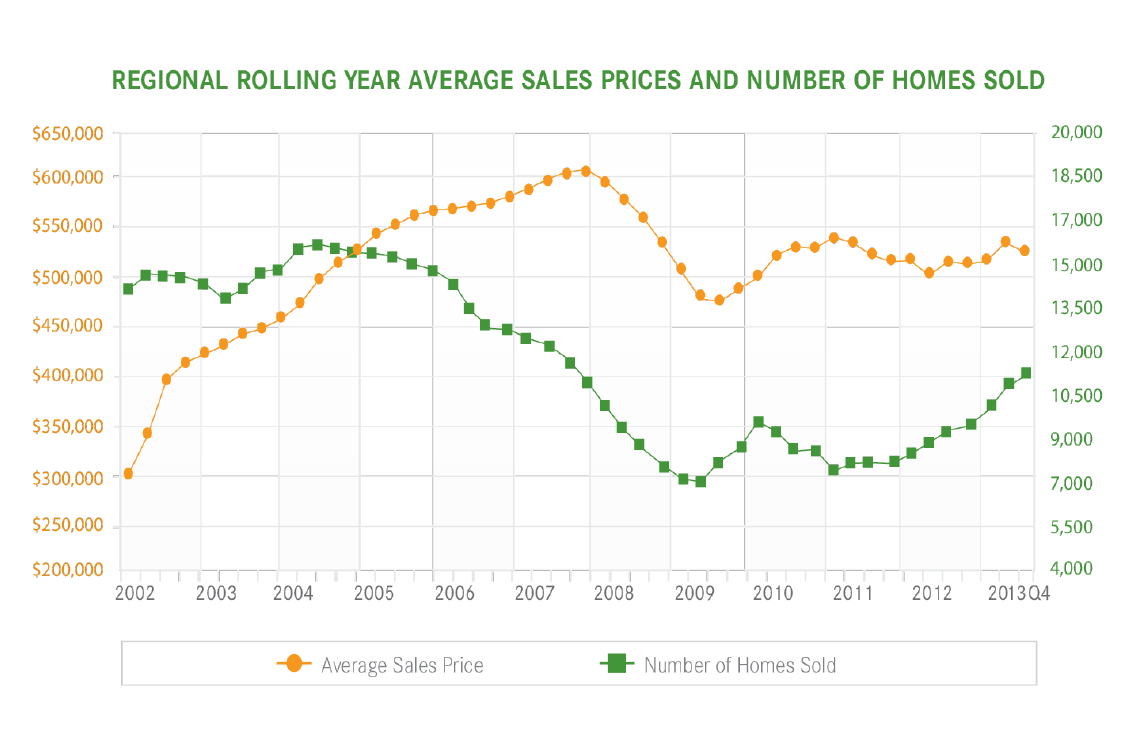 Once you’re on the market, you’re going to be interested in the market. You’ll be reading and watching everything in sight. But information about the national market can be misleading, so you want to make sure you focus your attention on your local markets and on interest rates.
Few people are as interested in the real estate market as those in the process of buying or selling a home. If you’re actually in the market, you watch the market: you notice every “for sale” sign you pass on the street, you stop and watch every television news report about the market, and you read everything that gets published in the papers.
That’s all fine. It makes sense that you’re going to be interested in the market. But we want to caution you not to believe everything you read, not because the media has a bias or is presenting misinformation, but because the media presents the wrong information.
Essentially, the media is not a good resource for following the market. Most of the news that gets reported is really “old news” about homes that were sold months ago, in places far away. National home sales, which are what the media generally covers, make no difference to you. It doesn’t matter to a seller in Hudson Valley, Westchester, and Northern New Jersey what the national sales figures are, because real estate is intensely local. Of course, you’re going to read those stories anyway, but don’t let them get you anxious about the market.
That said, it is absolutely crucial that you stay on top of your market. Too many sellers, and agents, complete a comparative market analysis when they put the listing on the market, then never keep track of developments in that market. But the market is changing all the time, and you need to be aware of those changes and, if necessary, adjust your pricing and marketing strategies. Even in the short term, movements in the market can affect whether your home is well priced, even if you and your agent did a great job of pricing to the market when you listed it.
What can affect the price of your home?
•Competing homes that come on the market at significantly higher or lower prices to your listing price.
•Comparable homes that close at significantly higher or lower prices.
•Changes in interest rates.
•The strength of the economy, particularly consumer confidence and unemployment.
So given that following the market is important, what information should you be tracking?
1. The Market Action Update
The best resource for you in following the market is the information you’re going to get from your agent. Every Monday, you’re going to get an email called the “Market Action Update” that will detail activity involving new listings that come on the market, price changes, and closings of comparable properties. The update can very broad, pulling in sales from your local area that are not strictly comparable to yours, but that does give you a general sense of the local market, which is what you want to follow.
2. The Rand Quarterly Market Report
Also, you will get a Quarterly Market Report from your agent that will give you a much more comprehensive view of what is happening in your county and the full region, with written analysis concerning transactions, sales prices, days-on-market, listing discounts, and prices-per-square foot. This is the kind of local analysis that is helpful, as opposed to the national sales figures that are just distracting. We have been putting out the Quarterly Market Report for over eight years, and have data going back almost 10 years, so we have a very good sense of what is happening in our local markets.
3. Interest Rate Changes
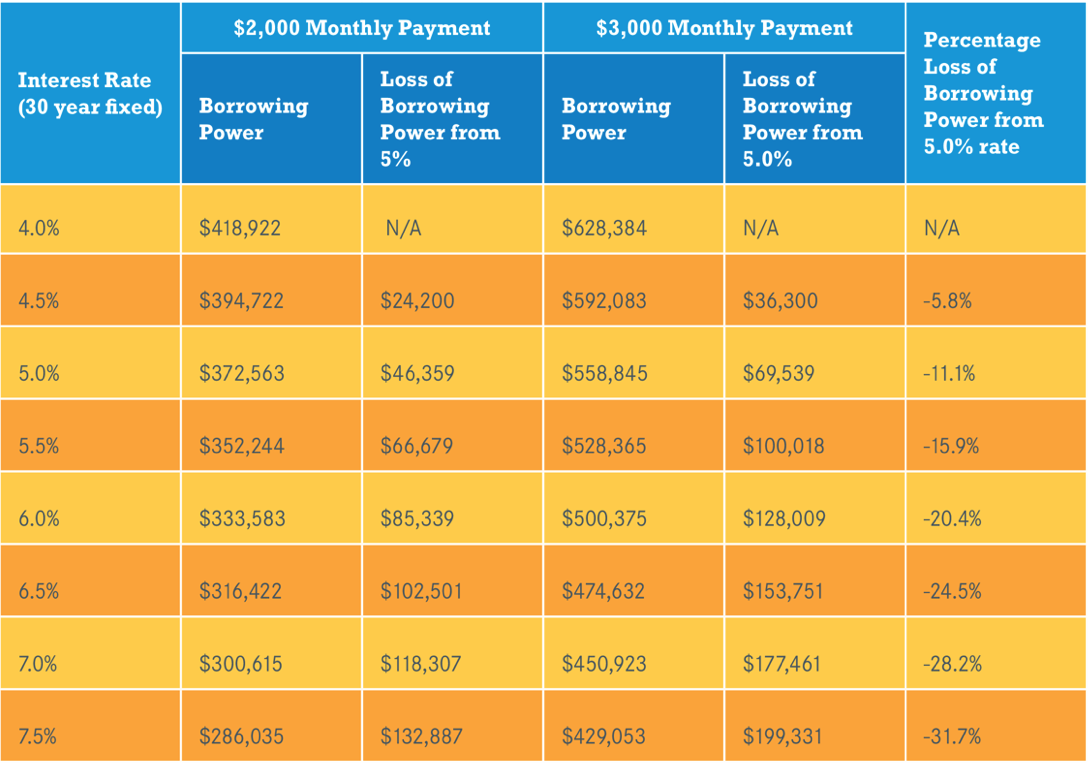
Nothing will affect your home value more than changes in interest rates. If rates go up, your home becomes attractive to more buyers even at the same price. And if rates go down, your home becomes less affordable to the buyers who might be in your price range. See the chart on this page, which shows the impact of rising interest rates on buyer purchasing power. A buyer who can afford a $2,000 monthly mortgage payment can borrow $372,563 on a 30-year fixed rate loan at 5.0%, but as rates go up in half-point increments, her buying power goes down significantly.
4. Economic News
Thought it’s difficult to tell you what economic news to follow, the basic idea is that a good economy is good for housing. If consumers are confident, then buyers will be confident and more likely to pull the trigger. So although general economic news is not specifically related to real estate, it does have an impact.
Conclusion
Of course, throughout this process, the best resource for information about the market is your Rand real estate agent. If you read something in the media that concerns you, or have a question about the market, reach out to get an answer. No one knows the local markets better than the agents who work in them.
How to Prepare Your Home For Showings
 The key to getting your home sold quickly and for the best price is making it available for showings whenever buyers want to see it. It’s one of the most annoying parts about having your home for sale, but it’s important to accommodate buyer schedules. You never know whether the person coming to see it today is going to be “the one.” To help you keep your listing in great showing condition, and almost as a last-minute “checklist” for things that you should do when buyers are on their way, here is a short guide to preparing your home for a showing.
1. Do a Quick Detailing
Just like the detailing you did when you first put the home on the market, you should walk through and make sure that you have maintained that clean, uncluttered look:
•Do a general cleaning of the home: not scrubbing, but wiping.
•Check for broken or dim light bulbs.
•Remedy any distracting or unpleasant odors.
•Make all the beds.
•Put away dirty clothes in a hamper or laundry machine.
•Do the dishes or at least have them in the dishwasher.
•Put away children’s and pet’s toys.
•Put away personal toiletries.
•Remove all things on front and side of refrigerator.
•Keep all pets in a contained space, or take them out with you.
•Sweep driveway and walkways.
•Clean up the yard of any toys or debris.
2. Do a Quick Staging
Staging can be as extravagant as a Broadway show, or as simple as a children’s recital. Keep it simple, but do the little things that create the effect you want:
•Turn on enough lights to brighten the rooms.
•Open curtains and shades to let in outside light.
•Open the windows if it’s nice out
•Keep the home in a temperate zone , with air conditioning or heating if necessary.
•Open the shower curtain to expose the shower or tub.
•Put out fresh towels in the bathrooms.
•Close all television cabinets and put away the remotes.
•Set place settings at dining room table.
•Put on some ambient music.
3. Protection Issues
Finally, remember that virtually all your visitors are legitimately interested in looking for a new home, but just in case you want to protect yourself:
•Secure all your valuables in a locked or non-obvious hiding place.
•Put away any breakable heirlooms that cannot be replaced.
•Put your mail away in a drawer.
•Put any important papers on your desk away in drawers.
Ten Things You Can Do to Help Get Your Home Sold

Having a home on the market isn’t a full-time job, bit it can seem like one. If you want to get your home sold as quickly as possible, and for the best price possible, there are some things that you, and only you, can do.
Having a home on the market can be a stressful and time consuming process, but we want you to be aware of ten things you can do to help get your home sold for the best possible price in the least possible time:
1. Keep up the property appeal.
Given all that time and energy you spent detailing, cleaning , and even maybe staging your home for the initial marketing push, you don’t want to put it to waste by allowing the appeal of the property to decline over time. Try to keep the home in the best showing condition possible: keep the house free of clutter, do the dishes every night, mow the lawn, keep the whole place clean. You should wake up every morning thinking, “This is the day that my buyer is going to come for a showing.”
2. Make the home available whenever possible.
Although it’s not possible to make the home available for show 24 hours a day, seven days a week, you should try to be available for showings at all possible times. You never know when your potential buyer is going to be available. And if you have certain challenges for showings (rambunctious pets , guests, etc.), try to minimize their effect on your availability.
3. Keep up with the market.
Keep track of what’s happening in the market, so that your pricing and marketing stay competitive as the market changes. Make sure to read your weekly email market update, and if possible go look at the competition on the market to see what buyers are going to be comparing to your home.
4. Be pleasant and upbeat with buyers you meet.
You’d be surprised how many sellers undermine their chances of selling their home by being difficult or disagreeable with potential buyers. Anyone who walks through the door is a potential buyer, so try to be upbeat and positive with them. If they like you, they’ll be more likely to give your home a fair chance. And ultimately, they will be easier to work with if they make an offer.
5. Don’t reveal anything to buyer agents.
Be careful in speaking directly with buyer agents. Be pleasant and helpful, but don’t reveal anything about your negotiability, your desire to close, or your timeframe. As they say on television cop shows, “Anything you say can and will be used against you” in a negotiation. Refer all questions to your agent.
6. “Manage” Your Property.
Your agent is in charge of the project of selling your home, but you’re the only person capable of being the “on-site ” manager of the property. Be sure to let your agent know if any problems come up with your listing: if the sign comes down, if you’re not going to be able to show it for a period of time, or if there is some damage to the property that would undermine the showing condition (i.e., a tree falls in the yard). If the problem is something we can correct, or help you correct, we’ll do so quickly.
7. Be proactive about getting ready to close.
When we do get offers, be quick to respond and communicate counter-offers through your agent. And while you’re on the market, get everything you need ready for your attorney: your deed, your tax bills, and any other legal documents relating to your purchase.
8. Don’t stress, or at least don’t communicate stress.
Buyers can sense when a seller is getting anxious, and take it as a sign of desperation. Your posture when you meet with buyers or buyer agents viewing the home should always be that you love the home, you hate to leave, and you’re not anxious to sell.
9. Let people know you’re selling.
Let your friends, family, work colleagues, and anyone else know that your home is for sale. You never know whether a friend of a friend is looking to move into your neighborhood. If you’re on Facebook, make an announcement about selling your home, with a link to your listing. Although very few homes sell from such word of mouth, since serious buyers are already looking for homes with agents or on the internet, it can’t hurt. (We understand you might be squeamish about telling people you’re selling, or revealing what your home is selling for, but remember that most people find out anyway, and home sales are public records).
10. Keep in touch with your agent.
Your Better Homes and Gardens Rand Realty agent is your best resource for information and advice about the market, and should be your shoulder to lean on. Your agent should be in consistent communication with you as often as you want, but don’t let too much time go by without getting in touch, even if it’s just for a quick update or a short conversation. The more communication, the better.
Getting Started with RandRealty.com

The first step in your home search process is setting yourself up on RandRealty.com, the premier real estate website in our region. In this section, you’ll find out about all the features on the site and learn how to register so that you can get email alerts for your saved searches and properties.
The Rand organization has always been one of the leading technology companies in real estate, recognized throughout the industry as a cutting-edge pioneer committed to providing our agents and clients with the best tools possible. The centerpiece of our dedication to technological innovation is randrealty.com, our award-winning website providing the best real estate search and property display features available in the industry.
The randrealty.com site has long been at the leading edge of the regional real estate industry. We were the first company to provide full multiple listing inventory, the first to add multiple pictures, the first to provide mapping and address information, the first to adopt blogging and social media integration. We are constantly innovating the site, adding new features and capabilities designed to provided our clients with the best experience possible.
Today, randrealty.com gives you access to every property for sale through all the multiple listing systems in the region, with powerful, intuitive and easy search features. We also provide access to innumerable resources that you might need during your home search, including market data, school reports, and even design and decorating videos and articles from Better Homes and Gardens.
Site Features
Here are some of the feature highlights of randrealty.com:
•All the listings. Randrealty.com is one of the few places you can go to get listings of the entire regional area, so you don’t have to look in different places if your search takes you across a county or state border.
•Powerful search tools. You can do quick searches right from the home page, or do an advanced search to pinpoint the types of homes you are looking for, including multiple area searches with simple check boxes (not those “hold down the CTRL-key while you….”-type systems).
•Open house listings. Open house listings are updated every week if you want to narrow your search just to homes available for public viewing that weekend.
•Community Insight. If you want to research the local area, you can find comprehensive demographic reports and school information for all our communities and school districts. And you should also check out Community Heartbeat, our lifestyle blog for our local communities, featuring local attractions, village and town profiles, and picture tours.
Ultimately, our goal is to make randrealty. com your bookmarked site for anything you need to know about local real estate, not only during your home search but after you close. Indeed, the site gets almost two million yearly visitors, about 100 times the number of people who buy a home in our region every year, which means that most of the visitors to our site aren’t even in the market to buy a home.
Property Detail Page
Once you’re done your searches on randrealty.com, you’ll notice the elegant, intuitive design of the property detail pages, which provide all the information available from the multiple listing system, and even more information for the many listings with our company. In addition, we have integrated a number resources into the site to give you features like mapping, demographic information, market data, and school information.
Here are some of the highlight features of the property detail pages:
•Up to 50 high-resolution photos. We display all the photos provided by the MLS in the highest resolution possible, with up to 50 photos available for our own listings.
•Full property descriptions. Unlike some sites, we do not have a maximum character count for our property descriptions, so you won’t miss out on a particularly lengthy home profile.
•Property addresses and mapping. Every listing has the property address and all Google map features, so you can see where the home is, toggle to a satellite view of the property on Google Earth, and get driving directions. The satellite views are particularly helpful for getting a sense of the property line and dimensions.
•The Toolbox. Every local area has its own “toolbox,” which is a collection of school reports, demographic information, and a community tour from the Community Heartbeat blog, so you can do in-depth research of that individual property.
•Sharing and printing options. You can share any property via email, or on any of a myriad of social media sites. You can also print an informational flyer if you want to get a copy of the property for your files.
•Saving options. You can save the property to your “favorites ” list to track it and register for email alerts on it.
Most importantly, randrealty.com provides you with all the information we can get from the local multiple listing system. We don’t prioritize our own listings, manipulate search results, or penalize other brokers by limiting the information we’ll provide on their listings, because that would not be a good service to you – the user of the site. We want you to feel comfortable relying on the information on randrealty.com as the most up-to-date, comprehensive, and accurate property information available on properties for sale in your area.
 Using National Real Estate Sites
 Using National Real Estate Sites
We truly believe that randrealty.com is the single best real estate website for doing home searches in our local region. If you want proof, just do some searches on randrealty.com, and then check the results, and the information displayed on the property detail pages, against any of our competitors – even the national sites.
Indeed, many of our clients come to us after using national real estate sites like Zillow, Trulia, or Realtor.com. Those are great websites, and we partner with them to display our listings, but they can’t compare to the sheer number of listings , the depth of informational detail on those listings, and the accuracy of randrealty.com. After all , the most important feature for any real estate website is timely, comprehensive, complete, and accurate data of the homes for sale, and none of the national sites have or display the amount of property information that we do:
•They don’t have all the listings. Brokers can (and often do) opt out of providing their listings to national sites, so those sites don’t have all the listings that are available on randrealty.com.
•They don’t provide all the listing information. Those sites make money by charging brokers to “upgrade” their listings with full displays of all the pictures and listing information. Some brokers don’t pay, so the sites often present a minimal number of pictures or truncated information.
•They are often inaccurate. The MLS inventories of properties for sale are huge and complex databases, and data errors are unavoidable. We look out for these errors and fix them when we find them, but the national sites have to monitor hundreds of MLS systems and can’t possibly keep the same level of attention that we can.
•Their search results are often misleading. Most of the sites, again based on their business models, manipulate search results to put certain properties higher in the results, which can often cause you to miss homes that might be more relevant to your query – but which did not pay to get a priority placement. All search results on randrealty .com display by default in price order from high to low.
The bottom line is that you’ll find more listings, with greater and more accurate information, on rand realty.com. With all that said , though, we certainly work with many clients who use both our site and one or more of the national sites, so you should do your research on whatever site works best for you.
Using the Site
•Saved Properties. You can save any property you’re viewing on the site by clicking the “Save Listing” link right underneath the photographs. That property will be saved to “My Homepage”, and you’ll get an email alert when any information on that property changes (e.g., price changes, new photos, etc.).
•Saved Searches. You can set up a saved search anytime you use the “Search” function on the site. Just be sure to check off the box labeled “Save this “Search” before you hit the “Search” button. Saved searches are great for two reasons: first, because they allow you to run a search right from your “My Homepage” without having to re-enter the criteria every time; and second, because those searches will generate email alerts to you anytime there’s a change to a property responsive to the search.
•Email Alerts. Whenever you get a “hit” on a saved search, or whenever information on a saved property changes, you’ll get an email alert at the email address you registered with. Make sure to add the “@randrealty.com” email domain to your “safe senders” list on your email account, to avoid having the emails mislabeled as spam. Also, it’s a good idea to set up a “smart folder” on your email account to segregate your randrealty.com email, so that you can find it easily and it doesn’t clutter up your inbox.
Staging Your Home

Detailing your home is just the first step in creating a great first impression. The next step is to “stage” your home to generate warmth, ambiance, and to simulate the imagination of your buyers.
You might be familiar with the concept of “staging,” since any number of cable television real estate shows have highlighted the impact that makeovers can have on home values. Staging is literally “setting a stage,” orchestrating interesting scenes in each room that attract the attention of your buyer audience and create appealing impressions.
Detailing is, of course, the first step of staging. Once you have cleared, cleaned, and neutralized your home, you can then take a step back and think about the impression you’re trying to create for your buyers. Most homes do not even need any extensive staging once the fundamental detailing work has been completed.
But if you do want to take that extra step and actually stage each room, consult with your agent about the impressions you want to create. You don’t need to be up on all the latest design fashions, or spend a fortune to stage your home. You just need a little bit of money, some common sense, and a commitment to spend some time examining your home in a different light. If you want expert assistance, then your agent can recommend a professional stager to come in and help.
The art and practice of staging could and has filled up books, but we will simply highlight some fundamental principles that you should keep in mind:
1. Accept that staging is all about style, not substance.
Staging your home requires that you think about the way your home looks, not about what it’s like to live in. It might be that the dining table is a convenient place to stack your mail and old newspapers, particularly if you never eat at it, but staging the home requires that you give up a little bit of convenience and ease-of-living to create the right impression. It’s like wearing high heels or a bow tie to a formal dance: not the most comfortable choice, but the one that creates the right impression.
If you stage your home, you have to sacrifice utility for style, and highlight how things look rather than how they fit into your life. Your buyer won’t notice that the vase of fresh flowers on the coffee table blocks the view of the television, or that there’s no garbage can in the master bedroom, or that it’s annoying to hang your coat in the foyer coat closet rather than on a peg in the laundry room. Your buyer doesn’t live there, so all she’s going to notice are the beautiful flowers in the family room, the clean lines of the bedroom, and the clutter-free laundry.
The nice part is that you’ll be living in one of those developer style “model homes.” The downside, of course, is that no one actually has to live in those model homes, so you’re going to have to sacrifice a little comfort to create those impressions.
2. Decide what story you want to tell about each room.
The best way to stage a room is to stand at the entrance point to each room, look around the room from that vantage, and think about what story you want to tell about the room. What story will appeal to your buyers? If it’s a dining room, consider actually setting the table with your best service, along with a dried flower arrangement as the centerpiece. Everyone who comes in will know that you’re not actually having a formal dinner that day, but the impression still gets made. The story is important, because it helps buyers visualize themselves living that life, in that home.
Moreover, every room needs a center of attention. In the dining room, it’s the table already set for a dinner. In the living room or great room, it might be a fireplace or wall-mounted flat screen television. In every room, you want to highlight a great feature and draw the buyer’s eye to it. If the room does not have a great feature, then you need to create one, using some accessories you can buy cheaply. A mass market vase filled with dried flowers on a mantle can change the focus of an entire room.
3. Mix textures, shapes, eye levels, and colors (within reason) in each room.
The key to staging is consistently attracting the attention of a buyer from room to room, drawing the eye where you want it to go. And the best way to keep buyers interested is to mix their eye levels – you want them looking up and down, side to side as they go through your home. It just makes things more interesting.
The same goes for textures, shapes, and colors. From a staging perspective, furnishings and accessories that are identically sized, shaped, and symmetrical are dull and uninteresting. You want to mix it up a bit with soft and hard things, square and round things, tall and short things, to keep up the variety.
The same goes for color. You want a splash of color in every room to draw the eye and create an interesting impression. But think of color like perfume: a little bit is great, and too much can be overpowering. Bold color can be used to highlight the best parts of a room, or it can be a distraction. If you have any concerns that adding some bold color will actually detract from the impression you’re trying to make, stick to neutral colors: beiges and light blues, reds, and greens. The same goes for patterns: don’t feel that you need to replicate the latest cutting edge styles from design shows when all you’re trying to do is create a pleasing impression to buyers coming to see your home. You don’t need to take risks when staging.
4. Don’t forget the other senses.
Most staging involves the eye, but the other senses come into play as well. It’s amazing how much the other senses can subtly affect the emotional response of a buyer, who may not even realize that the soft music in the background and the gently wafting scent of flowers is why she feels so relaxed in your home. You need to titillate those senses.
Engaging the ears of your buyers is easy. Just have soft music played during showings, unobtrusively in the background. The type of music depends on what type of response you’re trying to create: soft jazz if you’re trying to create a relaxing feeling, light classical (more strings than horns) if you want to send a certain upscale ambience, or even just light pop if you want things to be casual. If you don’t have a good sense of how music evokes a mood, go into one of your favorite restaurants or shops and listen to what they are playing to relax their customers.
Similarly, scents can be used in a positive way, even though most of the time that buyers smell things in a home it’s not a good thing. Once unpleasant smells are dispelled during detailing and cleaning, you want to use scents to evoke another type of emotional response. Again, you want a light touch (just like perfume) so you do not overwhelm. But the use of subtle positively-associated scents — flowers, cookies baking, even the faint scent of cleaning products in bathrooms and kitchens – can create an enormously favorable reaction.
5. Don’t spend a lot of money.
Finally, do not feel you need to spend a lot of money. Have you ever looked closely at the furniture and accessories that you find in a model home? Probably not. And neither will the buyers coming to your home. You can get great design and color ideas from a couple of design magazines that you can pick up at any bookstore, and incorporate them cheaply into your staging plan by picking up cheap items at discount stores. You’re not likely to keep any of your staging props, so you don’t need to spend money on them.
Should you hire a professional stager? If it were up to real estate brokers, we would urge every single seller in Hudson Valley, Westchester, and Northern New Jersey to hire a professional designer to stage a home for sale. We believe in the power of staging to sell your home. Even if you want to hire a professional stager, though, we would recommend someone who will do a consultation for a set fee, and then give you a chance to decide whether you want to go further. That said, a home seller who does a great job detailing and cleaning a home is about 80% of the way to a fully staged home, so the question is more about whether
you think it’s worth the investment in a stager to turn a good impression into a great one.
Getting Pre-Qualified


Getting a mortgage will be the most difficult part of your home buying process, but you can have a better experience if you get prepared and start working with your loan officer right from the beginning.
The hardest part about buying a home is getting a mortgage. For the most part, you will actually enjoy the home buying process: after all, looking at homes is like “shopping,” and most people enjoy shopping. Looking at homes online, going on showings with your agent, getting to know the different areas and neighborhoods – those are all the fun parts about buying a home.
But the mortgage process is messy, complicated, and often intimidating. That’s why we want you to be prepared. Our general advice to be engaged and proactive is particularly important for getting a mortgage. If you’re actively involved throughout the mortgage process, and if you start planning ahead now, you’ll have a much more pleasurable experience.
Because the mortgage process is so central to your home buying experience, you should have a general sense of how that process will develop:
•Initial Consultation. You’ll meet briefly with your loan officer and get a pre-qualification letter to advise you of your general price range.
•Application. Once you find a home to purchase, you’ll complete a formal mortgage application to your lender.
•Processing. Your loan processor, who works with your mortgage officer, will review your file and probably contact you about supplementing it with some supporting documentation.
•Underwriting. Your processor will submit the file to an underwriter, who could deny or approve the application, but will more likely issue a “conditional commitment” required more documentation or clarification.
•Clear to Close. Once you have satisfied all the conditions, your bank will issue a commitment letter and you will be “clear to close” your transaction.
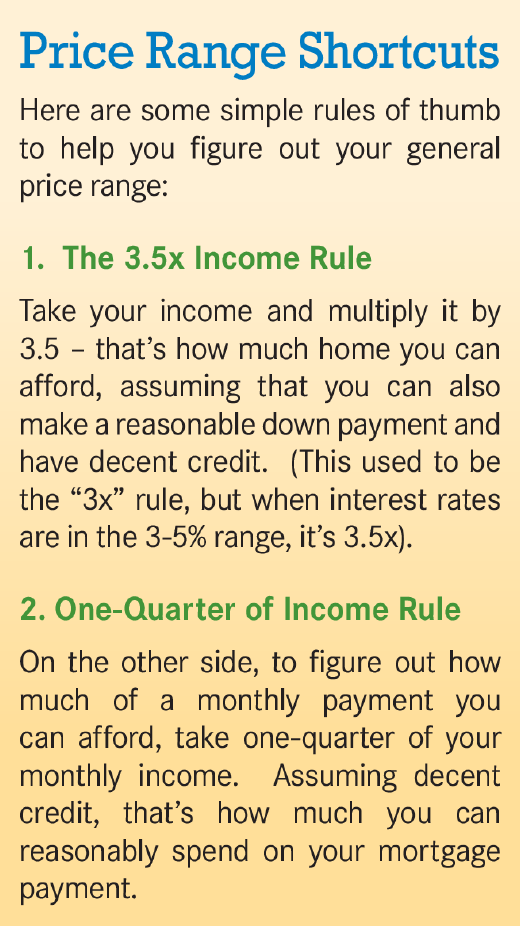 How can you be more engaged, so that you are better prepared? Most importantly, you should meet with a loan officer right away. At 1st Priority Mortgage, our affiliate lending company, we encourage our clients to meet with a loan officer right at the beginning of their home search, because even a short consultation can answer your questions about the current rate environment, assuage some of your concerns about the process, and also help you get a better sense of your buying power. Too many buyers start looking for a home without a clear idea of how much they can afford, and they waste a lot of time looking at homes that are above, or below, their actual price range.
At your initial consultation with your loan officer, you should be prepared to discuss in some detail your financial situation.
Remember that loan officers, at least the ones with 1st Priority, are under strict licensing requirements to protect the privacy of your information and keep your confidences, so you should feel free to discuss your personal situation without holding anything back. Your loan officer will review your financial profile, give you a general sense of your price range, describe the current interest rate environment, and explain the various mortgage products that might be available to you.
Most importantly, by having that initial consultation with your loan officer, you’ll be able to get a pre-qualification letter: a statement on the bank’s letterhead indicating that you have been “qualified” for a particular price range. Now, you should be aware that a pre-qualification letter is not a firm commitment from the bank – you won’t get anything like that until you complete and submit a formal loan application, which you cannot do until you actually find a home to buy. Rather, the pre-qualification letter is really just a general indication of your buying power.
But the pre-qualification letter is still important for two major reasons:
First, it will allow you to go through the process of discussing your financial situation with your loan officer, which will ensure that you have a good sense of your true price range before you go out and start looking at properties.
Second, and perhaps more importantly, a pre-qualification letter from a reputable lender like 1st Priority is almost a “stamp of approval” for sellers and listing agents. In a competitive environment for buyers, a pre-qualification letter indicates that you are credible and serious, and that you have the general financial wherewithal to back up your purchase offers. Indeed, many sellers demand a pre-qualification letter before they will even consider your offers!
If you do not yet have a pre-qualification letter, just call 1-866-721-7263 to speak to a 1st Priority Mortgage loan officer. We can arrange to get you pre-qualified over the phone and have a letter emailed or faxed to you immediately.
All that said, we should note that a pre-qualification letter is not a binding commitment from the bank. You won’t get any kind of formal approval until you have identified a property to buy and have submitted a full application to a lender.
Rather, the pre-qualification letter is designed to give you just a general idea of your price range, so that you have a better sense of what you can afford when you start looking for a home.
Accordingly, we strongly urge that you have a short sit-down with your loan officer early in your buying process. By forging that connection with your loan officer, you’ll secure one of the most important members of your home buying “team,” and someone you can then contact whenever you have financial questions or issues.
Conclusion
This is really only a general introduction to the mortgage process. If you want a more comprehensive overview of mortgage products, qualification guidelines, and interest rates, check out the 1st Priority Transaction Orientation Guide, which is available from your 1st Priority mortgage loan officer or your agent.
NMLS #29600. Contact 1st Priority Mortgage, Inc. for mortgage products and eligibility. 1st Priority Mortgage, Inc. is a Licensed Mortgage Banker, New York State Department of Financial Services-License number LMBC 107183. The Connecticut Dept. of Banking Consumer Credit Division-License number ML-29600. The Florida Office of Financial Regulation-Division of Consumer Finance-License number MLD2477. The New Jersey Dept. of Banking & Insurance. The Pennsylvania Department of Banking and Securities as a Mortgage Lender-License number 104688. All lending products are subject to credit and property approval. Terms, conditions, and certain restrictions may apply on all programs. Interest rate and program terms are subject to change without notice. This is not a commitment to lend. Contact a 1st Priority Mortgage Consultant for full details. 6000 Sheridan Drive, Williamsville, NY 14221 (888) 500-9733.