Facebook
 X
X
 Pinterest
 Copy Link
Second Quarter 2017 Real Estate Market Report – Northern New Jersey Market Overview
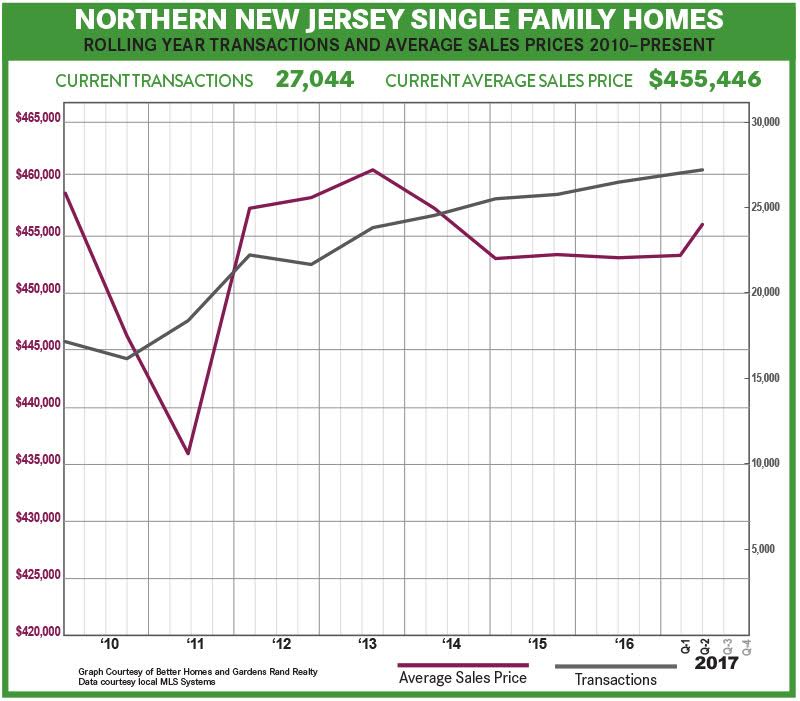
 The Northern New Jersey housing market surged again in the second quarter of 2017, with another sharp increase in sales coupled with some more meaningful signs of price appreciation. With inventory levels continuing to fall throughout the region, we expect that sustained buyer demand will drive a robust seller’s market through the Summer and the rest of 2017.
Sales surged throughout the region. All the Northern New Jersey markets continued their strong start to the year, with regional sales up almost 8% and transactions rising in every market in the region: up 1% for Bergen houses, 9% for Bergen condos, 8% in Passaic, 3% in Morris, 13% in Essex, and 25% in Sussex. For the rolling year, sales were up almost 8%, reaching sales levels we have not seen since the height of the last seller’s market. Indeed, regional sales are now up over 70% from the bottom of the market in 2011.
The number of available homes for sale continues to go down. We calculate the “months of inventory” in a market by measuring the number of homes for sale, and then figuring how long it would take to sell them all given the current absorption rate. The industry considers anything less than six months to be a “tight” inventory that signals the potential of a seller’s market that would drive prices up – and we’re now right at that level. Indeed, inventory was down from last year in every individual county in the Rand Report: Bergen single-family homes down 12%, and condos down 29%; Passaic down 31%; Morris down 31%; Essex down 24%; and Sussex down 26%. If inventory continues to tighten, and demand stays strong, we are likely to see more upward pressure on pricing.
With sales up and inventory down, prices are starting to show some “green shoots” of modest price appreciation. Basic economics of supply and demand would tell us that after five years of steadily increasing buyer demand, we would expect to see some meaningful price increases. And we’re starting to see some promising signs: the regional average sales price was up almost 2% from last year’s second quarter, and the average price was up in every county other than Sussex. Looking at the long-term, the rolling year average sales price was up just a tick, but was up in every county other than Passaic.
Going forward, we remain confident that rising demand and falling inventory will continue to drive price appreciation through the rest of 2017. Sales have now been increasing for five years, which has brought inventory to the seller’s market threshold in much of the region. The economic fundamentals are all good: homes are priced at 2004 levels (without even adjusting for inflation), interest rates are still near historic lows, and the regional economy is stable. Accordingly, we continue to believe the region is poised for a robust Summer market and a strong 2017.
To learn more about Better Homes and Gardens Real Estate Rand Realty, visit their website and Facebook page, and make sure to “Like” their page. You can also follow them on Twitter.
Second Quarter 2017 Real Estate Market Report – Dutchess County, New York
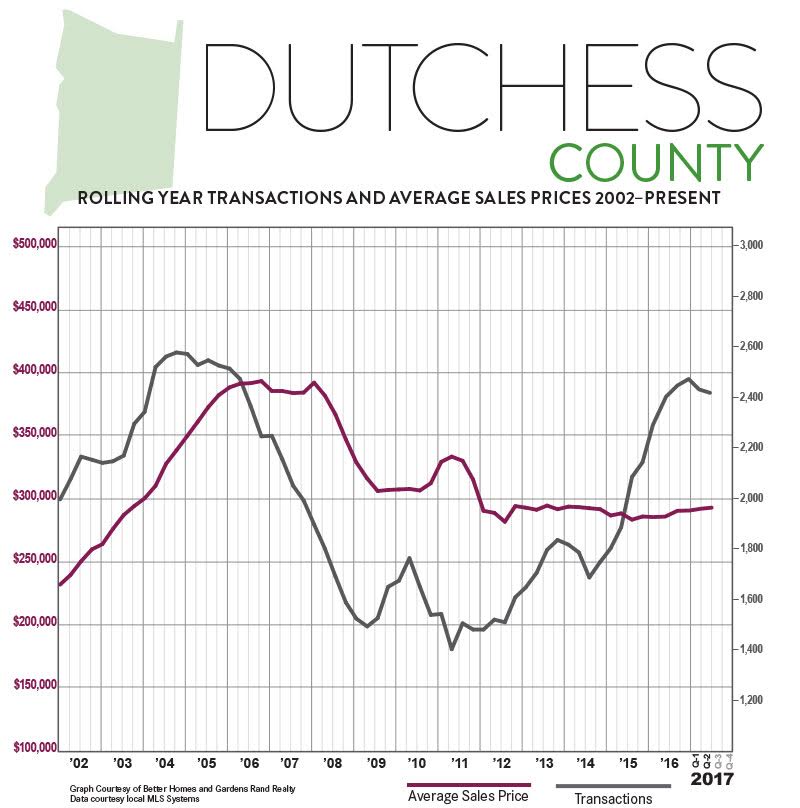
 The Dutchess County housing market showed clear signs of an emerging seller’s market in the second quarter of 2017, with the first meaningful signs of price appreciation in years.
Sales. Dutchess sales were down a tick for the quarter, probably a reflection of falling inventory in the market. For the rolling year, sales are still up a tick, but Dutchess definitely needs some “fuel for the fire” to accommodate strong buyer demand.
Prices. Home prices showed the first signs of life in a long time, with pricing up across the board: rising almost 5% on average, 3% at the median, and over 8% in the price-per-square foot. We can see the same story in the rolling year numbers, indicating that Dutchess is moving into a sustained seller’s market.
Negotiability. Dutchess inventory declined sharply in the second quarter, down 51% from last year. This might be partly caused by a change in the way we are measuring Dutchess inventory, so we don’t know that the percentage change is reliable. But the prevailing months of inventory at 7.5 months does support the idea that we’re moving into a seller’s market.
Condominiums. The condo market was up sharply after a slow start to the year, with sales up almost 52% from the second quarter of last year. Similarly, prices were way up for the quarter, with meaningful appreciation for the rolling year. The condo market is in great shape right now.
Going forward, we still believe that the Dutchess market will have a strong summer. With tightening inventory, a stable economy, near-historically-low interest rates, and homes still priced at appealing 2003-04 levels, Dutchess is likely to see meaningful price appreciation through the end of the year.
To learn more about Better Homes and Gardens Real Estate Rand Realty, visit their website and Facebook page, and make sure to “Like” their page. You can also follow them on Twitter.
Second Quarter 2017 Real Estate Market Report – Putnam County, New York
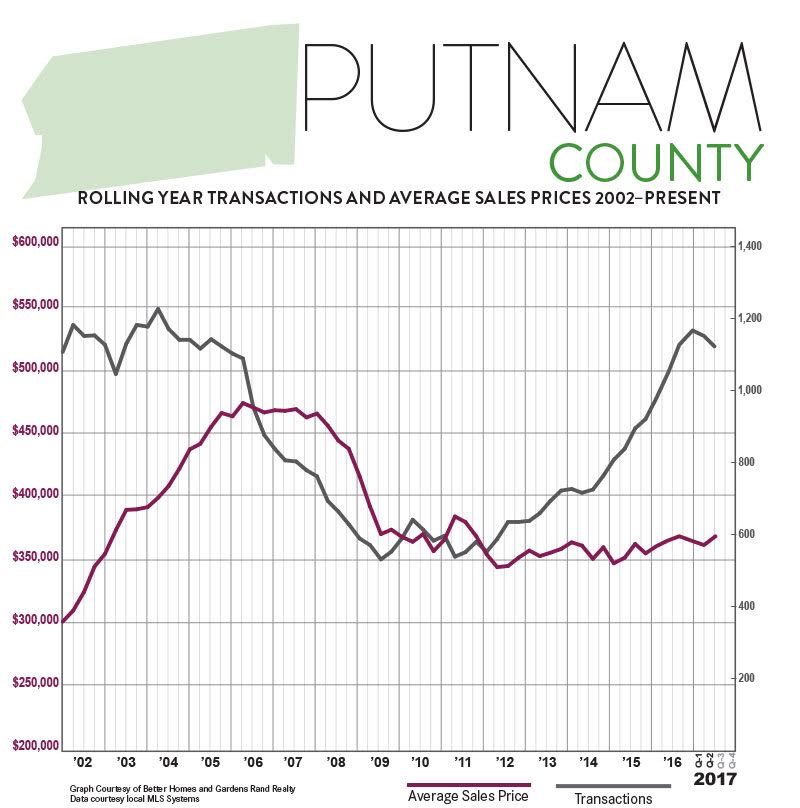
 The Putnam County housing market showed the clear signs of constricted inventory levels, with a slowdown in sales coupled with a spike in pricing.
Sales. Putnam single-family home sales were down over 12% for the quarter, the second straight quarter of a significant decline in transactions. After over five years of steadily increasing sales, Putnam is now seeing the impact of a lack of inventory, with sales now flat for the rolling year.
Prices. The lack of inventory is also having its impact on pricing, which was up across the board: rising over 6% on average, almost 10% at the median, and almost 2% in the price-per-square foot. For the year, the pricing results are more mixed, with the average down just a tick, the median up a tick, and the price-per-square-foot flat. We have been expecting meaningful appreciation in Putnam for some time now, and still believe that low levels of inventory and stable demand will continue to drive prices up this year.
Inventory. Inventory continued to tighten, falling 23% and now down to the six-month level that usually denotes a tightening seller’s market. This lack of available homes is what’s been restricting sales, since we don’t have enough “fuel for the fire” to keep the market going. But it’s also driving prices up, as buyers chase and compete for the limited inventory that’s available.
Negotiability. The negotiability indicators support the idea that a seller’s market is emerging, with the listing retention rate up just a tick and the days-on-market continuing to fall. This is exactly what we would expect in a strengthening seller’s market — homes selling more quickly and for closer to the asking price.
Condos. The impact of low inventory on the condo market was even more severe, with sales down almost 18%. In this case, though, prices also fell, dropping over 10% on average and over 13% in the median. The Putnam condo market is very thin, though, with only a few dozen sales, so we try not to read too much into one quarter’s worth of data.
Going forward, we believe that Putnam is poised for a strong 2017, especially if some new inventory comes onto the market to satiate the available demand. The fundamentals of the market are tremendous: inventory is low, rates are near historic lows, and prices are still at attractive 2004-05 levels.
To learn more about Better Homes and Gardens Real Estate Rand Realty, visit their website and Facebook page, and make sure to “Like” their page. You can also follow them on Twitter.
Second Quarter 2017 Real Estate Market Report – Orange County, New York
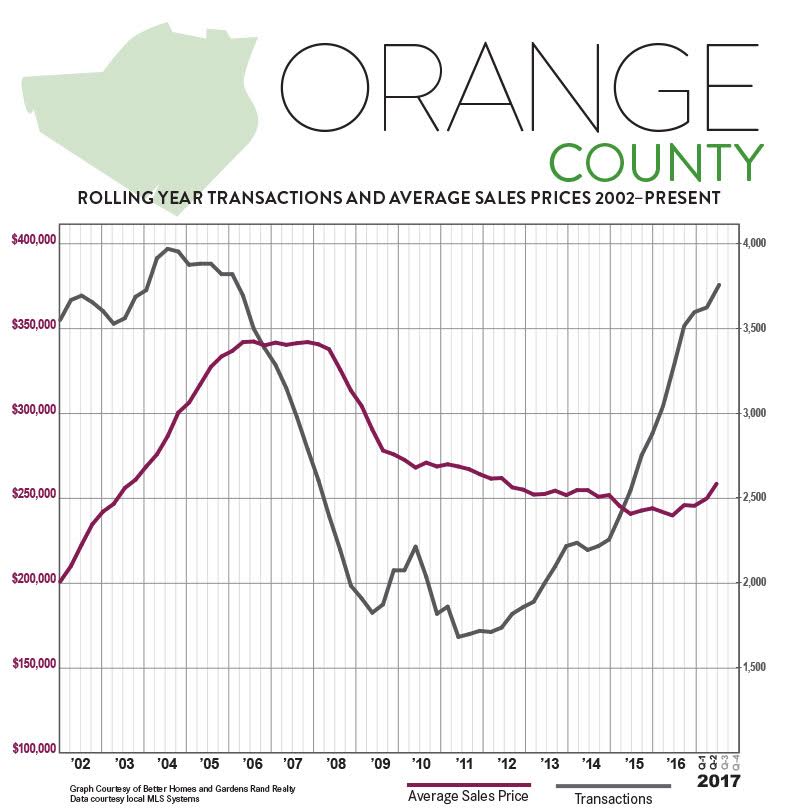
 The Orange County housing market surged again in the second quarter of 2017, with both sales and prices up sharply while inventory continued to fall.
Sales. Orange sales were up yet again, rising over 6% from last year’s second quarter. Quarterly transactions have now gone up in 11 straight quarters and 20 out of the last 21. Indeed, for the rolling year, sales were up almost 13%, and the 3,655 single-family sales were the highest total we have seen since the second quarter of 2006 — at the height of the last seller’s market.
Prices. These sustained levels of buyer demand are finally having their expected impact on pricing. Home prices surged again in the second quarter, rising 9% on average, almost 7% at the median, and over 5% in the price-per-square foot. And home prices are now showing meaningful signs of appreciation over the longer-term, with the rolling year prices up over 5% on average, 4% at the median, and 3% in the price-per-square foot.
Negotiability. The available inventory continues to tighten, with the months of inventory falling almost 25% and now down close to the six-month level that usually indicates a seller’s market. Meanwhile, homes are selling more quickly and for closer to the asking price, with the days-on-market falling and the listing retention rate rising.
Condominiums. The condo market was also up sharply, continuing a welcome trend that we finally saw in the first quarter. Sales were up almost 27%, and prices were up sharply. We wouldn’t read too much into the eye-popping quarterly results, but even the rolling year totals were impressive: up 4% on average, over 2% at the median, and over 4% in the price-per-square foot.
Going forward, we believe that the Orange County housing market is poised for a strong summer. The fundamentals are tremendous: demand is high, prices are still at attractive 2003-04 levels, interest rates are at historic lows, and the economy is generally strong. With inventory continuing to decline, we expect to see meaningful price appreciation through the rest of 2017.
To learn more about Better Homes and Gardens Real Estate Rand Realty, visit their website and Facebook page, and make sure to “Like” their page. You can also follow them on Twitter.
Second Quarter 2017 Real Estate Market Report – Rockland County, New York
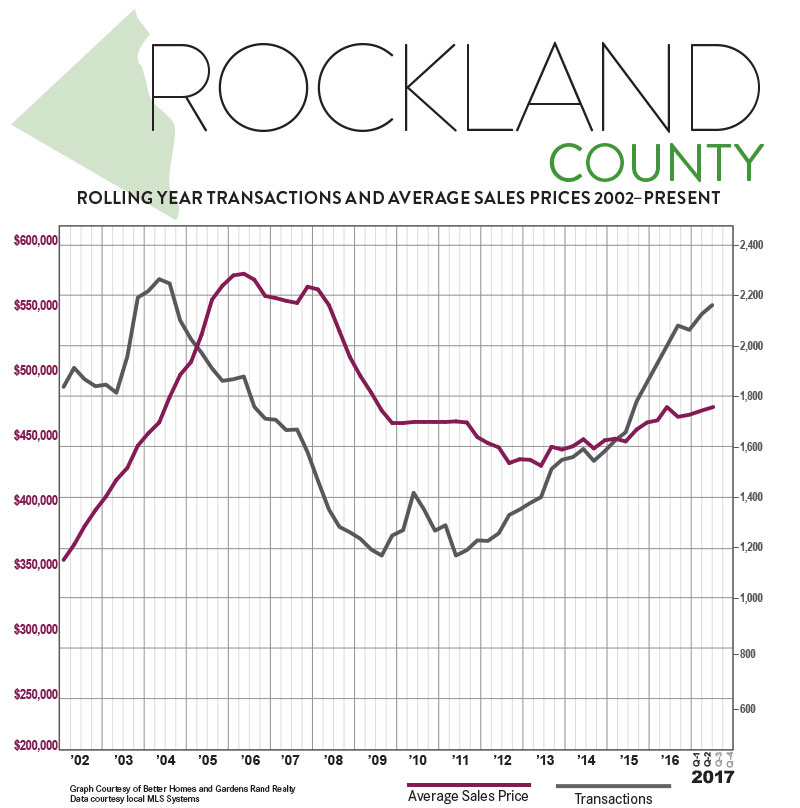
 The Rockland County housing market cooled down a little in the second quarter, with transactions and prices up only slightly after a sizzling start to the year, as the lack of inventory continues to stifle sales growth.
Sales. After spiking almost 24% in the first quarter, sales cooled down in the second, rising a little over 4% from last year. But this did continue a trend we’ve been watching for almost three years, the tenth time out of the last 11 quarters that year-on-year sales have gone up. Indeed, the 2,154 sales over the past rolling year marked the highest 12-month total since the third quarter of 2004.
Prices. These sustained increases in buyer demand are starting to have a tangible impact on pricing. Home prices were up for the quarter across the board, rising over 1% on average, almost 3% at the median, and over 1% in the price-per-square foot. And we are seeing meaningful and sustainable price appreciation over the longer term, with the rolling year median price and price-per-square-foot up over 2%. Similarly, Rockland’s average is now up over 11% from the bottom of the market in 2012.
Negotiability. Inventory continued to fall in the second quarter, depriving Rockland of the “fuel for the fire” that would drive more sales growth. The months of inventory fell almost 19%, and is now consistently at that six-month level market that denotes a seller’s market. Similarly, the listing retention rate rose and the days-on-market fell sharply, indicating that sellers are gaining negotiating leverage with buyers.
Condos. The Rockland condo market absolutely surged in the second quarter, with sales up almost 36% and prices up almost 7% on average 4% at the median. For the year, sales are up over 32%, and prices are showing the first signs of life in years. With inventory falling almost 40%, and now down to well below six months, we expect that prices will continue to rise.
Going forward, we expect that Rockland will have a strong summer market, with prices up and sales rising as much as they can with these levels of inventory. With prices still at attractive 2004 levels, interest rates near historic lows, inventory falling, and the economy generally strengthening, we believe that sustained buyer demand will continue to drive meaningful price appreciation through the rest of 2017.
To learn more about Better Homes and Gardens Real Estate Rand Realty, visit their website and Facebook page, and make sure to “Like” their page. You can also follow them on Twitter.
Second Quarter 2017 Real Estate Market Report – Westchester County, New York
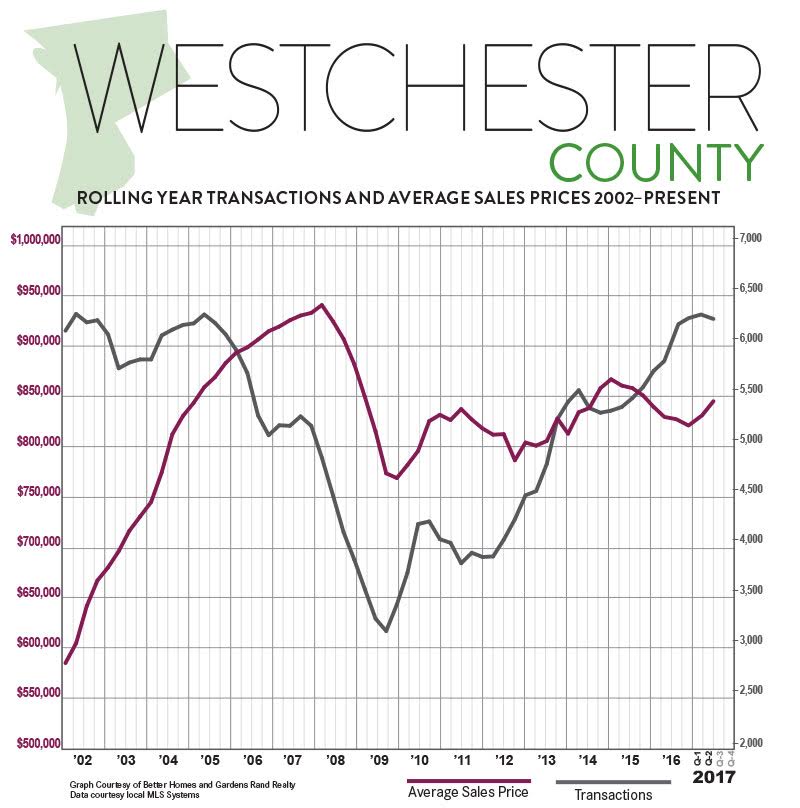
 Prices in the Westchester housing market surged forward in the second quarter of 2017, even while a lack of inventory stifled potential sales growth.
Sales. Home sales were basically flat through the second quarter, falling just about 1% from the second quarter of last year. This marked the first quarter in almost three years where sales fell from the prior year, reflecting the lack of inventory available in the market. Still, though, sales are at levels we have not seen since the last seller’s market in 2005, and up almost 90% from the bottom of the market at the end of 2009.
Prices. Low levels of inventory also had an impact on prices, which were up significantly over last year. Home prices rose across the board: up over 7% on average, almost 4% at the median, and 3% in the price-per-square foot. Over the longer-term, we’re starting to see some meaningful price appreciation, with average prices up almost 3% for the rolling year.
Negotiability. The negotiability indicators continue to signal the emergence of the seller’s market. Inventory declined again, falling almost 12% and now at the lowest level of inventory we have had in Westchester in over 12 years, since the height of the last seller’s market. Similarly, the listing retention rate was up a full percentage point, exactly what we would expect when sellers start to gain negotiating leverage.
Condos and Coops. The condo and coop market was mixed. Sales of coops were up over 12%, but condo sales were down over 6%, the clear result of constricted inventory levels. But that shortage of available condos and coops is having its expected impact on pricing, which was up across the board for both property types.
Going forward, we expect that Westchester is going to continue to see meaningful price appreciation through a strong summer market. With inventory still tightening, pricing at 2004-05 levels, and interest rates still near historic lows, we expect that buyer demand will stay strong for the rest of the year.
To learn more about Better Homes and Gardens Real Estate Rand Realty, visit their website and Facebook page, and make sure to “Like” their page. You can also follow them on Twitter.
Second Quarter 2017 Real Estate Market Report: Westchester & Hudson Valley – Market Overview
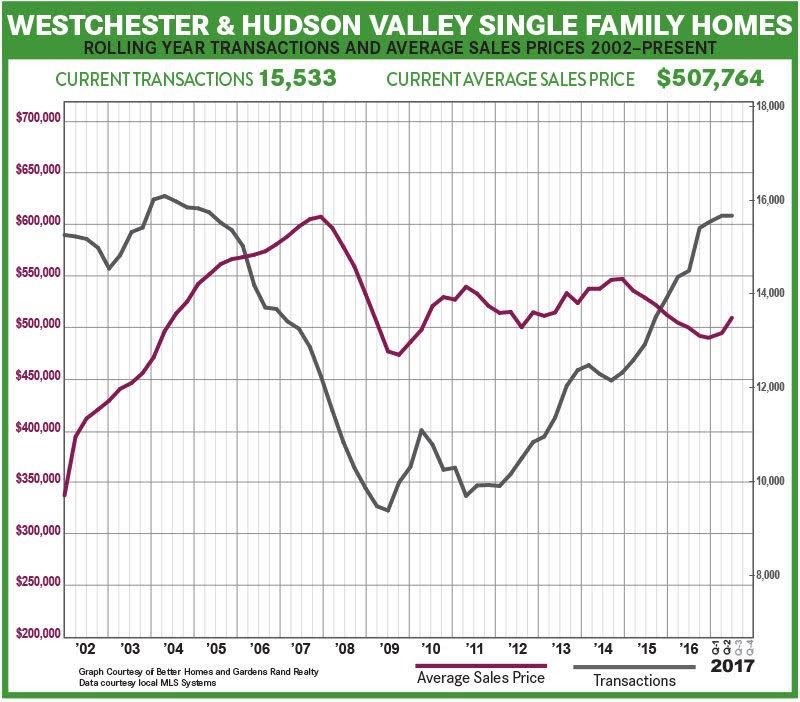
 The housing market in Westchester and the Hudson Valley continued to show signs of meaningful price appreciation in the second quarter of 2017, with prices up in every county in the region. With inventory rates dropping, and demand strong, we expect this trend to continue through a robust Summer market and through the rest of 2017.
Inventory throughout the region continues to drop. Regional inventory was down almost 18%, and is now down to 7.1 months — right at the level that the industry considers a “balanced” market. But many of the individual counties in the region are now down around six months, moving into “seller’s market” territory.
The lack of inventory continues to stifle sales growth. Regional sales were down just a tick compared to the second quarter of last year, just barely breaking a 10-quarter streak of year-on-year sales growth. We noted in our last report that the pace of growth was slowing. Now, it has stalled, at least until we get more “fuel for the fire.” All that said, buyer demand is as strong as we’ve seen in over 10 years, with regional sales up 5% for the year and reaching the highest 12-month sales total since the height of the last seller’s market in 2005.
These inventory levels are starting to drive meaningful price appreciation. The regional average sales price was up over 6% for the quarter, following a similar 7% increase in the first quarter. After several years of slow declines, prices are now up over 1% for the rolling year. That may not seem like much, but it’s a sign of things to come. Indeed, average prices were up in every county in the region, rising over 7% in Westchester, over 6% in Putnam, over 1% in Rockland, 9% in Orange, and almost 5% in Dutchess. We should not be surprised — sales have been going up year after year, and it was only a matter of time before this type of demand drove some meaningful price appreciation.
Going forward, we expect that prices will continue to appreciate through the rest of the year. Demand is strong, bolstered by near-historically-low interest rates, prices that are still near 2003-04 levels (without controlling for inflation), a generally strong economy, and sharply declining inventory. We will need fresh new listings to drive more sales growth, but we expect that we will continue to see price appreciation through a robust Summer market and throughout 2017.
To learn more about Better Homes and Gardens Real Estate Rand Realty, visit their website and Facebook page, and make sure to “Like” their page. You can also follow them on Twitter.
Making Your Move

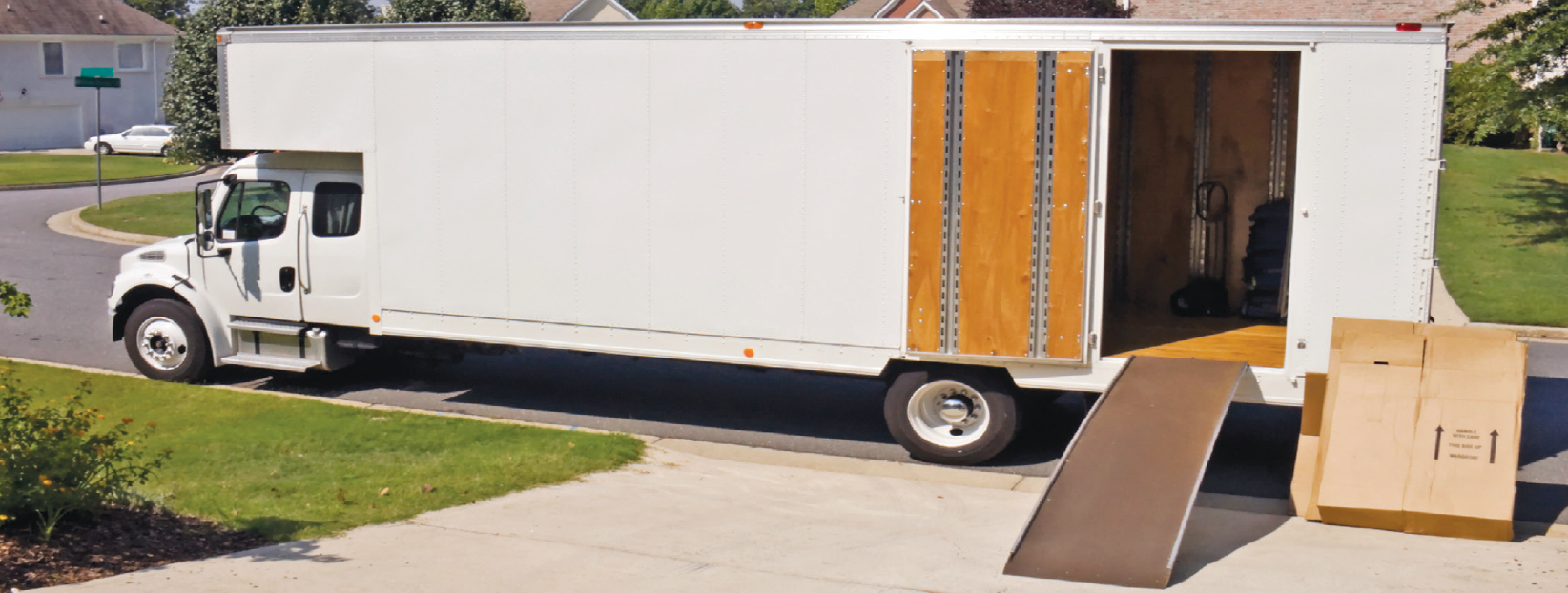
For most of us, moving is an unusual experience that can be stressful and difficult. It doesn’t need to be that way. Planning ahead, getting solid estimates, and engaging with your movers can give you a feeling of control over your move and provide you with a much better experience.
For most people, moving is like getting your car repaired. You don’t do it that often, you hate having to do it, you don’t understand it very well, and you worry that you’re going to get overcharged. We all fear the evil stereotype: movers who break things, lose things, or give deliberately low estimates before raising the price once our belongings are all on the truck.
Those really are just stereotypes, and your experience does not have to be like that. While predatory movers exist, most reputable companies do a terrific job helping customers move massive amounts of heavy and precious things across the region or the country, and they do it for a reasonable price. Your agent has experience in recommending movers, so trust in a referral to someone who has a sound track record.
As with all things involved in buying your home, being proactive and engaged can help you have a better experience. Accordingly, here are some tips for ensuring that you have a great experience in moving:
Before the Move
•Plan Ahead
Don’t wait until the last minute to start hiring a mover, or you’ll end up not being able to get scheduled in time, you might have to pay more, and you’ll be doing everything in a rush. You can start planning your move as soon as you are in con tract , or at the very latest as soon as you are clear to close with your lender.
•Do it Yourself, or Let the Movers Do It
You basically have two options about the type of move you want. In the standard option, you need to pack all the small items into boxes, seal them up, label them, and then have them ready for the movers. You don’t need to box big items, or carry the big items anywhere, but you need to pack up things like clothes, books, dishes, cookware, silverware, files, knick-knacks, things like that. That can be an onerous job. The other option is to pay extra for the movers to do all that for you. People who have experienced that full service option will never go back to packing themselves, because it is a glorious feeling to watch the movers descend upon your home and quickly pack, seal, and label all your things. It’s an easier way to move, but also a better one, because the movers are much, much better at safely and quickly packing your things than you are. Trust us, it’s worth the money.
For those people who choose to pack for themselves, more and more find that a portable storage locker that can be placed in on-site helps them to pack at a more leisurely pace. These large portable storage containers can be at your home for a number of weeks and allow you to pack while you have time. They are later picked up and moved to your new location on the day of your move.
 •Interview Up to Three Reputable Movers
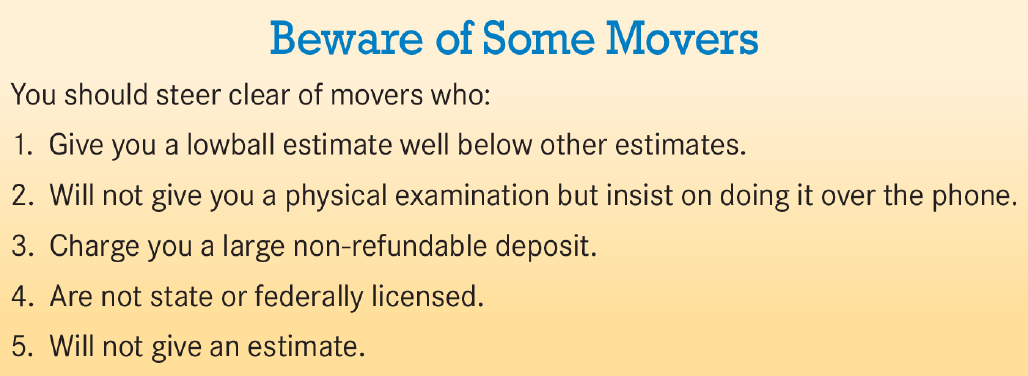
One of the reasons to get started early is so that you have time to interview up to three reputable movers to get estimates. Let the movers examine your things, get a full sense of the scale of the move, and give you an estimate. You can learn a lot about the movers just from the way they interact with you, and get a chance to choose a mover based on your gut feeling on who you would like the most. That said, if you get a referral from your agent for one mover, and you like that mover, you shouldn’t feel the need to go interview two more just to feel like you’ve done your due diligence.
•Get a Physical Survey as Part of Your Estimate
The mover’s estimation process should include a physical survey of all the things that you need to move, rather than simply an over-the-phone or internet questionnaire. Professional movers have a good eye for the requirements of a move, and most of us do not. They will pick up on things that you won’t. In our experience, many problems between movers and customers stem from a customer’s unreasonably low estimation of the amount of work that needs to be done, leading to an inaccurate estimate. Never hire movers that refuse to do an in-house survey and instead assure you that they can give an accurate estimate over the phone or internet.
•Do Not Pay a Large Deposit
Very few reputable movers will charge a large deposit on a routine move. They might charge a good faith down payment to reserve their time, but nothing too substantial. Be wary of movers who want to charge you a large up-front payment or, even worse, charge you for the move before they have actually delivered your goods to your new location.
•Consider Your Insurance Options
When you move, you have the right to get moving insurance. Insurance comes in three levels of protection: “Full Replacement,” which costs the most and guarantees the full repair or replacement of any goods lost or broken; Assessed Value Coverage, which is based on the estimated cost of replacing the assessed value of goods lost or stolen; and “Alternative Level of Liability,” which only pays out liability at a standard rate of 60 cents per pound. You will find that in most cases it is worth getting “Full Replacement” insurance, but it really depends on the content, distance, and comfort level associated with your move.
•Before You Move, Get Rid of Stuff You’re Not Going to Want in the New Home
Don’t pay to move things that you’re never going to need or use again. Moving is a great opportunity to pare down your life, eliminating items that you’ve been storing for years. Go over those items carefully. A lot of times, you boxed them up in your last move years ago “just in case” you needed them. The rule of thumb is that if they have spent more than four or five years boxed up without being needed, you’re not going to need them in your new place, either. So donate them, hold a garage sale, or throw them away.
 The Day of the Move
 The Day of the Move
 On your moving day, be engaged with the movers. Moving day can be difficult and stressful, but you will have a better experience if you fully engage with the movers and stay on top of everything. Be home when the movers arrive with everything you need to do already done, so you can focus on discussing delivery arrangements. When the moving out is complete, and you are ready for transport, make sure the movers have a phone number to reach you, and that you have their number in case you want to contact them.
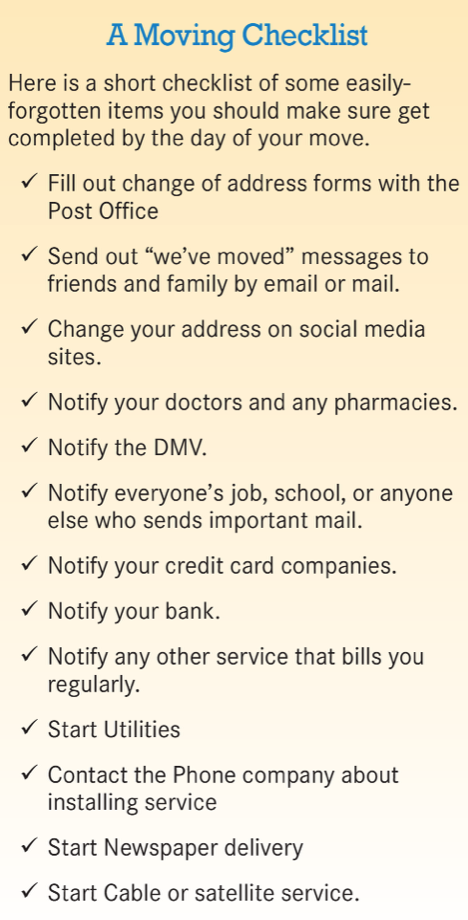
•Pack Your Personal Items Separately and Keep Them Segregated
Even with the best movers, and the best intentions, delays can happen. That’s why you need to make sure that you separately pack your personal items: changes of clothes, medications, toiletries, etc. The easy way to do this is just to imagine that you’re going on a three-day vacation or business trip, and pack a suitcase with everything you’ll need in those three days just in case the movers have difficulty getting to your new home. Even if the move can be completed in one day, and you’re not worried about that, having your “three-day vacation” suitcase separately packed allows you to unpack the rest of your stuff without the pressure of, say, trying to find the box that has your hair dryer.
•For Truly Valuable or Irreplaceable Items, Keep Them with You
Even if you have great and trustworthy movers, you’re going to want to take certain items along with you, or have them shipped separately in fully insured packages with a shipping carrier. Personal mementos, cash, coins, jewelry, precious photographs, and important papers should not be packed into a box and sent along with your clothes and books. Keep them separate.
 •Once Your Goods Arrive, Let the Movers Do the Moving
Let the movers do the work, you supervise. Make sure they get everything off the truck, and let them do the unpacking of the boxes while you tell them where everything should go. Many people seem to feel guilty of making these poor movers carry all that heavy stuff, and they want to pitch in. Don’t pitch in. That’s not your job, that’s their job, and they’re getting paid for it. What you need to do is your job: supervise to make sure everything comes off the truck and the boxes are put in the correct rooms.
•Provide Your Crew with Coffee, Water, Lunch, and a Tip
This is not required, but it’s always a good idea to have bottled water and coffee available for the movers when they arrive, and to offer to pick up pizza or a quick lunch while they’re working. It’s better for you to run out and buy them lunch than for them to take an hour off in the middle of the day. And providing water and coffee is just humane for people who will spend hours lugging your things around. If you get good service, and want to tip the crew, the best guideline we can give you is about $10-$25 per person who was part of the crew for the whole day. As with all services like this, tips are not required but appreciated.
•Don’t Move and Close on the Same Day
Finally, one last piece of advice about moving: don’t move on the day that you close on the sale. A closing can be stressful event that doesn’t happen very often, and moving is a stressful event that doesn’t happen very often. There’s no reason to do them both on the same day. You should plan for your move no earlier than a day or so after the closing, so you can get one big stressful day behind you before you turn to the next one.
Conclusion: Your Realtor for Life
At Better Homes and Gardens Rand Realty, we believe that our obligation to our clients extends beyond the closing. As part of our Client-Oriented Real Estate (CORE) program, we follow the philosophy that our clients need real estate related services even when they’re not buying or selling real estate. After all, your accountant is still your accountant, even though you probably only work with him or her once a year when you do your taxes. In that same way, we believe that our agents should continue to work with you, and our company should continue to provide you with services, even after your closing.
Now, you might be thinking, “what do I need a real estate agent for if I’m not buying or selling real estate?” Well, think of it this way – who would you call if you were in any of these situations?
•You need a recommendation for a good landscaper.
•You want to know whether adding a pool would raise or lower your property values.
•You need a market valuation for a tax grievance petition, or for your home insurance.
•You are thinking of renovating your kitchen, and wonder how much it will impact your home’s value.
•You’re wondering what that home down the block just sold for.
•Or you’re just curious as to what’s happening in the market
In all these situations, you really just need a good real estate agent. An agent can give you recommendations for various home service professionals (and probably some good restaurants, dry cleaners, and the like as well), can advise you about renovations or home improvements and how they’ll impact your property values, can get you all the information you need about the market, and can even do a comparative market evaluation any time you need it.
The same holds true for our Hudson United home services companies for mortgage, insurance, or title. If you ever have questions about your mortgage, insurance, or property title, you should feel free to reach out to us. For example, if you’re concerned that someone might have put a lien on your property without your permission, you should absolutely get in touch with us so we can provide you with a complimentary lien search to check the status of your title.
But we’re not just going to wait until you reach out to us with something that you need. Rather, at Better Homes and Gardens Rand Realty, we’ve created a series of programs to deliver services to you on an ongoing basis. For example, you’ve already seen that we’ve provided you with information about having a great move and grieving your property taxes. We feel it’s our job to help you with anything that relates to real estate, anytime you need us, regardless of whether these matters come up following the closing of your home.
You should feel free to reach out to your agent with anything you need, but in the meantime, we hope you enjoy some of the services we will continue to provide you as a client of the firm:
The Rand Quarterly Market Reports. The same quarterly market reports you’ve probably been reading during the course of your home search will be delivered to you either through the mail or via email. This is a great way to keep track with what’s going on in the real estate market. After all, your home is probably one of the biggest investments you have, so you should be watchful as to what’s happening with local market values.
The Rand Seasonal Event Guides. Along with the market reports, Better Homes and Gardens Rand Realty provides four seasonal guides to community events throughout the region – everything from parades to street fairs and exhibitions. It’s a great way to get to know the region and to take advantage of all the wonderful things to do in the area.
Better Homes and Gardens Magazine. When you buy your home through us, you’ll be getting a complimentary yearlong subscription to Better Homes and Gardens Magazine, one of the most popular magazines in the country and the iconic source for information about everything having to do with maintaining and improving your home and life.
Why do we do all this? That’s a good question. Most agents don’t even consider providing these non-transactional services for a very simple reason: they don’t get paid for it. But we believe that we owe our clients a higher duty than just guiding them through a home purchase or sale. Moreover, we are thinking of the long term, and the hope that you will someday need our services to sell that home that we just helped you buy. And in the meantime, we truly hope that you will recommend Better Homes and Gardens Rand Realty and your agent to anyone you know who might need real estate services.
We believe we’re the only company in the country prioritizing the delivery of great service to clients, even non-transactional clients, as a foundation of our business. That’s what our CORE client care program is all about, and what this Orientation Guide has been about. We hope you’ve see the difference in the experience that you’ve had with us, and in the experience that you’ll continue to have with us.
From everyone at Better Homes and Gardens Rand Realty and the Hudson United companies, we wish you the best of luck in your new home.
Keep in touch…
Understanding the Closing


The real estate closing can be confusing, but mostly it can be boring. The attorneys do all the work, and you will mostly sit around making small talk between long bouts of signing big documents. The seller has even less to do, so you might not even see the seller for most of the closing.
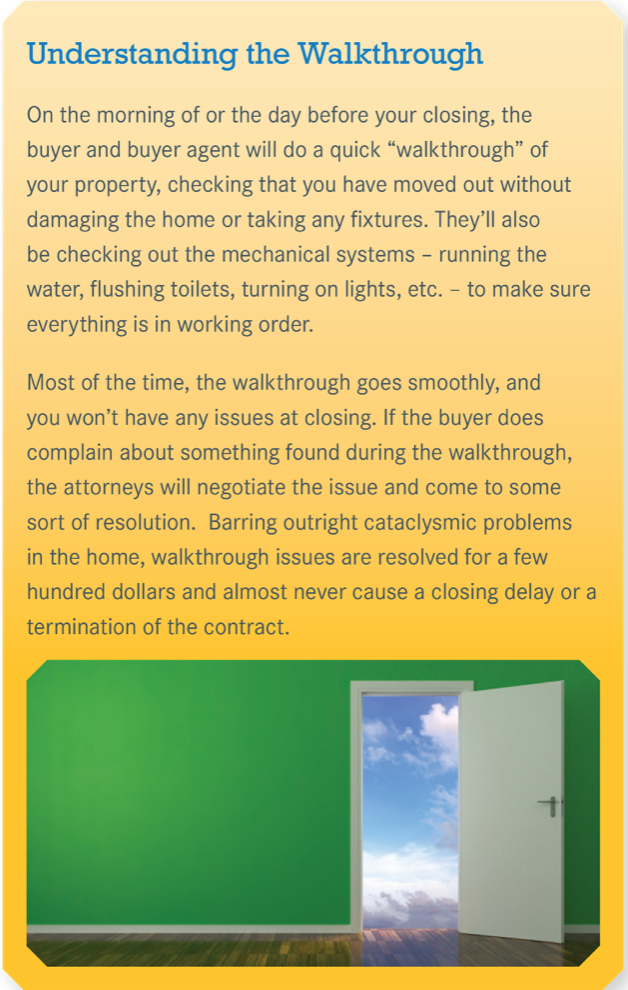
On the morning of or the day before your closing, the buyer and buyer agent will do a quick ” walkthrough” of your property, checking that the seller moved out without damaging the home or taking any fixtures. They’ll also be checking out the mechanical systems – running the water, flushing toilets, turning on lights, etc. – to make sure everything is in working order.
Most of the time, the walkthrough goes smoothly, and you won’t have any issues at closing. If you do find something wrong during the walkthrough, the attorneys will negotiate the issue and come to some sort of resolution. Barring outright cataclysmic problems in the home, walkthrough issues are resolved for a few hundred dollars and almost never cause a closing delay or a termination of the contract.
Once your walkthrough is complete, you’re ready to close. When you’re getting ready to go to the closing, don’t forget that you’ll need two very important things. First, you’ll need your checkbook, because you’re going to have to write a few checks to cover your closing costs, beyond the bank check you’ll be getting for the down payment. Second, you need your driver’s license (or some legal form of photo ID), because you’ll need proof of identity for the attorneys and the title closer. Your attorney will let you know what else you’ll need.
The basic dynamic of a closing is simple and involves three parts:
1) the buyer completing paperwork to get financing from a lender,
2) the seller transferring ownership of the property to the buyer, and
3) the lender giving the seller a check.
What happens at the closing is simply the execution of various forms that give final confirmation to the agreements made in the contract of sale between you and the seller, and the mortgage commitment between you and the lender.
That said, closings can be confusing to the lay person, because attorneys use a lot of jargon and shorthand in trying to facilitate a complicated process quickly and efficiently. To give you an idea, here is an overview of what happens at a closing:
The Participants
In addition to the buyer, buyer’s attorney, seller, and seller’s attorney, there are two other significant participants at the closing:
•The closer. The closer is usually employed or contracted by the title company issuing title insurance for the buyer, and will actually run the closing as an intermediary between the seller’s and buyer’s attorneys. The closer is also the person who will ultimately take your deed, your proof of ownership, to be recorded in the county clerk’s office.
•The bank attorney. The bank attorney represents the lender in the transaction, and is there basically
to make sure the loan documents are executed correctly. The buyer’s attorney sometimes is authorized to double as the bank attorney.
Of course, the closing might involve some other support personnel, chiefly paralegals and other assistants. And the real estate agents might show up in shows of support and to keep you company, even though they don’t have any formal role in the closing itself.
The Buyer’s Financing
Most of the time at the closing will be taken up by the buyer finalizing agreements with the lender on the mortgage terms. The lender will have a series of complicated documents that the buyer needs to understand and sign in order to obtain the loan necessary to buy the home, including the following:
•Truth in Lending Statement, which is federally required to disclose the actual financial terms of the loan.
•Itemization of Amount Financed, which tallies up the actual cost of the financing.
•The Monthly Payment Letter, which breaks down monthly payments into principal, interest, taxes, and insurance.
•The Note, which is the loan agreement between the borrower and lender.
•The Mortgage, which is the lien put on the home by the lender to provide collateral to the Note.
Once all that is completed, you are now in a position to purchase the property from the seller. For most of this process, the seller won’t have much to do. The seller did all her work months ago when she prepared her home for sale. The closing is where you are the main actor.
Transfer of Ownership
Now, the attorneys will begin having the seller execute documents that will transfer ownership from the seller to the buyer. These documents include:
•The Settlement Statement (HUD-1), which contains all the settlement charges associated with the transaction.
•The Deed, which is the actual document that transfers ownership from the seller to the buyer.
•Proration Agreements, which are simply side-agreements to the contract that prorate the housing costs (taxes , HOA fees, utilities) according to the date of the closing. For example, if the seller paid the property tax bill for the year three months ago, the buyer will be reimbursing the seller for 75% of that bill, since the seller lived in the home for only 25% of the year. The attorneys will be hunched over calculators for much of this process while they use standard formulas to figure out who owes what to whom.
•Receipts. Both parties might have to sign tax and utility receipts indicating awareness that certain costs have to be paid by one side or the other.
•Name Affidavit. At some point, the attorneys will ask you to provide identification proving that you are who you say you are, and ask you to sign a document attesting to your identity. That’s to make sure that you are the person legally allowed to transfer title.
•Summary. The final document of the closing, listing all the documents that executed and included as part of the closing.
When that’s done, you will get a copy of all your documents, and the title closer will be rushing off to the county clerks’ office to record your new deed (and the mortgage on that deed). At that point, you are done, so congratulations are in order.
Understanding the Closing – Sellers Perspective

 The real estate closing can be confusing, but mostly it can be boring. The attorneys do all the work, and the buyer has a lot more documents to sign and figure out than you do. But after all the work you did getting the home on the market and living through the marketing process, you deserve a bit of a break.
The basic dynamic of a closing is simple and involves three parts: (1) the buyer completing paperwork to get financing from a lender, (2) you transferring ownership of the property to the buyer, and (3) the lender giving you a check. What happens at the closing is simply the execution of various forms that give final confirmation to the agreements made in the contract of sale between you and the seller, and the mortgage commitment between the buyer and the lender.
That said, closings can be confusing to the lay person, because attorneys use a lot of jargon and shorthand in trying to facilitate a complicated process quickly and efficiently. To give you an idea, here is an overview of what happens at a closing:
The Participants
In addition to the buyer, buyer’s attorney, seller, and seller’s attorney, you’ll see two other significant participants at the closing:
•The closer. The closer is usually employed or contracted by the title company issuing title insurance for the buyer, and will actually run the closing as an intermediary between the seller’s and buyer’s attorneys.
•The bank attorney. The bank attorney represents the lender in the transaction, and is there to make sure the loan documents are executed correctly. The buyer’s attorney sometimes is authorized to double as the bank attorney.
Of course, the closing might involve some other support personnel, chiefly paralegals and other assistants. And the real estate agents might be there to show of support and to keep you company, even though they don’t have any formal role in the closing itself.
The Buyer’s Financing
Most of the time at the closing will be taken up by the buyer finalizing agreements with the lender on the mortgage terms. The lender will have a series of complicated documents that the buyer needs to understand and sign in order to obtain the loan necessary to buy your home, including the following:
•Truth in Lending Statement, which is federally required to disclose the actual financial terms of the loan.
•Itemization of Amount Financed, which tallies up the actual cost of the financing.
•The Monthly Payment Letter, which breaks down monthly payments into principal, interest, taxes, and insurance.
•The Note, which is the loan agreement between the borrower and lender.
•The Mortgage, which is the lien put on the home by the lender to provide collateral to the Note.
Once all that is completed, the buyer is in a position to purchase the property from you. For most of this process, you won’t have much to do and will be making small talk with everyone at the table, while the buyer gulps furiously and contemplates how much he will have to pay in interest over the full 30 years of his loan.
 Transfer of Ownership
 Transfer of Ownership
Now, with the buyer ready to go and a lender waiting to give you a check, the attorneys will begin having you execute documents that will transfer ownership from you to the buyer. These documents include:
•The Settlement Statement (HUD-1), which contains all the settlement charges associated with the transaction.
•The Deed, which is the actual document that transfers ownership from you to the buyer. At some point in the process, you’ll be signing that document, which signs away your ownership rights.
•Proration Agreements, which are simply side-agreements to the contract that prorate the housing costs (taxes, HOA fees, utilities) according to the date of the closing. For example , if you paid the property tax bill for the year three months ago, the buyer will be reimbursing you for 75% of that bill, since you lived in the home for only 25% of the year. The attorneys will be hunched over calculators for much of this process while they use standard formulas to figure out who owes what to whom.
•Receipts. You might have to sign tax and utility receipts indicating your awareness that certain costs have to be paid by one side or the other.
•Name Affidavit. At some point, the attorneys will ask you to provide identification proving that you are who you say you are, and ask you to sign a document attesting to your identity. That’s to make sure that you are the person legally allowed to transfer title.
•Closing Statement. The final document of the closing, listing all the documents that executed and included as part of the closing.
The Check
When that’s done, you get a check for the sale of the home. The check will usually be an odd-looking number, because various deductions and additions will be made at the closing (usually calculated
by the attorneys before the closing) for offsets like the tax and utility bills. But once you sign over the deed, and accept the check, you’re at the end of the home selling process. And you deserve some congratulations.